Heated socks for ice fishing, where the cheapest watt is the one you do not lose
Ice over water is not cold ground. It is a thermostat with a lake behind it, it cannot warm up under your boot, and it is wet on purpose. Insulate downward before you spend anything on a battery.
By Scooter M. · Published October 24, 2026
How this is funded: buy links here are tagged and earn us a commission at no extra cost to you. It does not affect what we recommend, and we take no free product and no sponsorship. Read the disclosure.
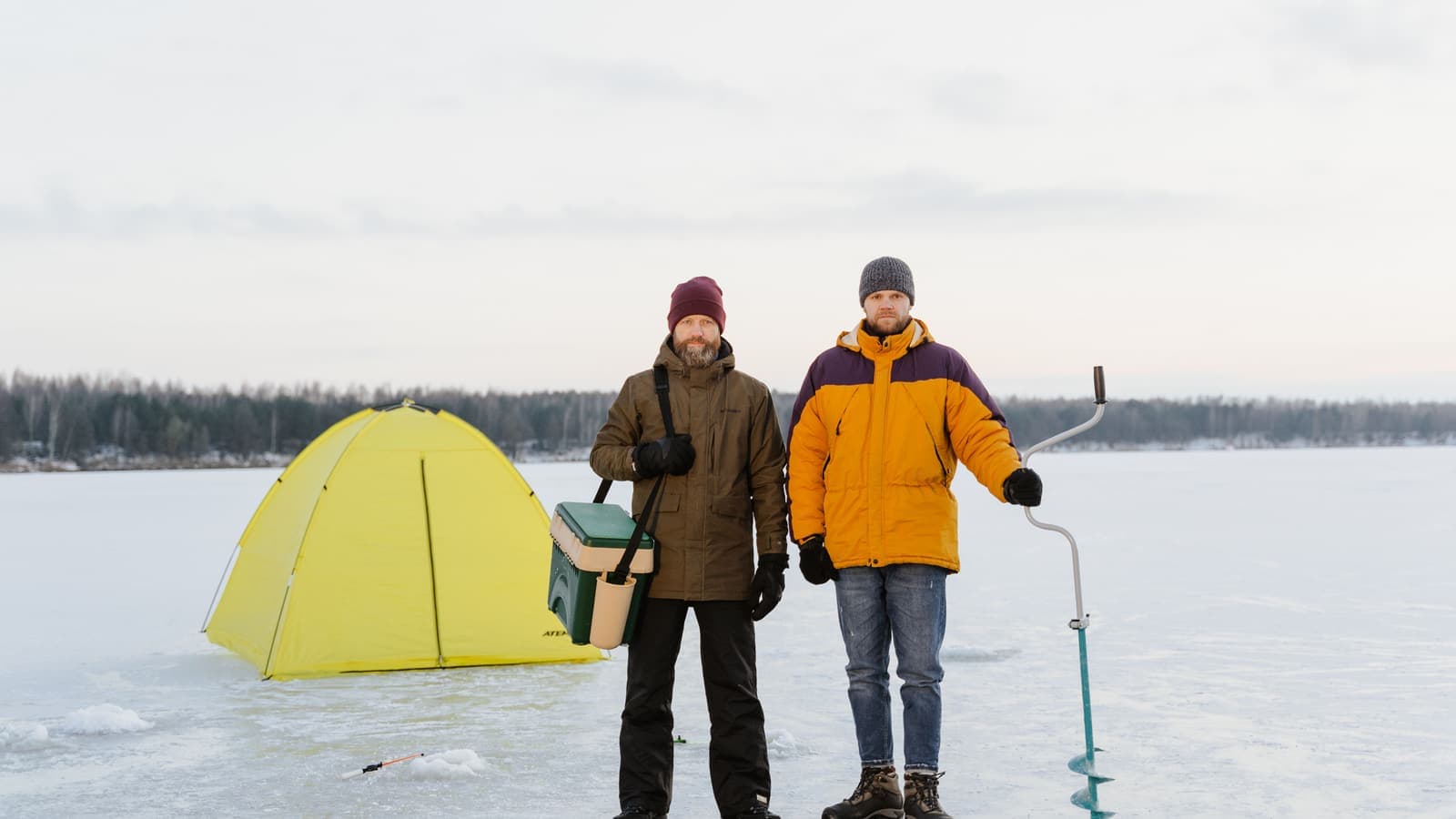
Put something between your boots and the ice before you buy anything electrical. A sheet of ice floating on water sits pinned at freezing with a lake behind it, so it will absorb heat from your soles all day without warming up - and a foam pad or a sled deck removes that loss for a few dollars. Then a heated sock is worth buying, and because you are in and out of a shelter you can run a small pack far longer than its label suggests.
Ice is not cold ground
Our hunting page already makes the general point that feet on frozen ground lose heat by conduction far faster than they would to still air. That is true here too, but ice fishing differs from a tree stand in three ways that change what you should buy.
- A sheet of ice over liquid water cannot warm up under your boot. Frozen ground gives up a little heat to your sole and the patch beneath you rises a degree or two; snow cover insulates it further. Lake ice is in contact with water at the freezing point across its whole underside. The surface you are standing on is held at that temperature by a body of water, which for your purposes is an unlimited sink. You are not warming a patch of anything.
- The water is there on purpose. Holes, slush, a landed fish, a wet line. A wet boot sole conducts far better than a dry one, because liquid water displaces the insulating air held in the sole's texture. The gloves page for this covers what that does to your hands; underfoot it shows up as a conduction path you keep refreshing.
- You can get off the ice, and a hunter cannot get out of the tree. That single difference changes both the energy arithmetic and the control you should pay for.
Quick picks
Tap any row to jump to the full write-up below. The energy column is the pack’s capacity times its voltage — the number this category does not print.
| # | Product | Best for | Energy | Price |
|---|---|---|---|---|
| 1 |  SNOW DEER Heated Socks with App ControlSNOW DEER's answer to the app-controlled sock, on the same 7.4 V pack family — which means the same energy budget and … | App control on the cheaper platform | 16.3 Wh | $95.99View on Amazon |
| 2 |  Dr. Warm R4 App-Controlled Heated InsolesThree settings published as 113°F, 122°F and 131°F with 7, 4 and 3 hours against them — the most complete insole spec … | A temperature AND a runtime for every setting | 8.1 Wh | $62.99View on Amazon |
| 3 |  SNOW DEER Heated Socks, 7.4VThe reference point for the category, and the rare heated product whose pack capacity is actually published — on the r… | The default heated sock | 16.3 Wh | $79.99View on Amazon |
| 4 |  Muddy Outdoors Nucleus Heated SocksA 40% merino blend with 3,500 mAh a foot and eight hours claimed on low — from a brand that publishes no voltage, no w… | The longest low-setting claim from a named outdoor brand | — | $99.99View on Amazon |
| 5 |  THE HEAT COMPANY Insole Foot Warmers (Air-Activated, 12 Pairs)No electronics at all — iron powder oxidising in air for 9+ hours a pair, which outlasts every rechargeable insole on … | Nine hours, no battery, no controller, no cable | — | $24.90View on Amazon |
#ad — buy links are tagged and earn us a commission at no extra cost to you. Prices come from a live feed; where none is available the button reads “Check price” rather than showing a number we cannot stand behind. How we are funded.
SNOW DEER Heated Socks with App Control
SNOW DEER's answer to the app-controlled sock, on the same 7.4 V pack family — which means the same energy budget and the same silence about wattage.
#ad Price as of October 24, 2026. How we are funded.
The numbers
- Energy
- 16.3 Wh
- Pack
- 7.4 V, 2,200 mAh per sock
- Control
- App plus button
- Use
- Motorcycling, hunting, skiing
- Heat zones
- Toe box
- Settings
- App-variable plus button presets
- Care
- Machine washable with the battery out
On wattage: No published wattage.
What we like
- Same replacement-pack ecosystem as the standard SNOW DEER sock
- App control at a lower price than most
- Machine washable
What we do not
- No wattage published
- App polish is not its strength
- The cuff pack is bulky under a tight boot
Who this suits
Someone who wants app control without paying for the premium sock.
Who should skip it
You want the best-executed app. This is the cheaper implementation and it feels like it.
Spec sources: SNOW DEER — App-control heated socks product page ("effortlessly adjust both socks at once, or customize each sock individually"; timer "set the timing between 0-3 hours" with auto power-off; "3 temperature settings"; "can last up to 11 hours on a single charge"; "designed to be washable for easy maintenance"; no voltage, capacity, per-setting temperatures, per-setting runtimes, app name or warranty published) · Amazon — SNOW DEER 7.4V 2200mAh replacement pack
Dr. Warm R4 App-Controlled Heated Insoles
Three settings published as 113°F, 122°F and 131°F with 7, 4 and 3 hours against them — the most complete insole spec sheet we found, on a brand whose own two pages disagree about the battery.
#ad Price as of October 24, 2026. How we are funded.
The numbers
- Energy
- 8.1 Wh
- Maker's stated energy
- 3.7 V, 2,200 mAh per foot — about 8.1 Wh
- Temperatures
- 113°F / 122°F / 131°F — published
- Runtimes
- 7 h / 4 h / 3 h — one for each setting
- Certification
- CE, RoHS, FCC, UKCA, UL, DOE per Dr. Warm
- Heat zones
- Full-length element, per Dr. Warm
- Settings
- Three, with temperatures published: 45°C, 50°C and 55°C (113°F, 122°F, 131°F)
- Care
- Do not submerge in water; clean the surface gently with a soft, damp cloth, per Dr. Warm
On wattage: Not published, but the arithmetic is clean: 8.1 Wh over the stated 3 hours on high is about 2.7 W, over 4 hours about 2.0 W, and over 7 hours about 1.2 W. A smooth descending ladder from a single pack size is what a calculated spec sheet looks like — which makes the capacity disagreement between Dr. Warm's own pages the more annoying, because these runtimes only work with the 2,200 mAh figure.
On the pack: 3.7 V and 2,200 mAh per foot on Dr. Warm's R4 specification page, which is about 8.1 Wh. A second Dr. Warm page for the same R4 says 1,500 mAh, which would be 5.6 Wh. We have used the larger figure because it is the one published alongside the per-setting runtimes, and it is the one those runtimes are consistent with.
What we like
- A temperature and a runtime for every setting, which is more than most heated JACKETS publish
- The runtimes invert into a smooth 2.7 / 2.0 / 1.2 W ladder, so they look calculated rather than invented
- A serious certification list, including UL
- App and remote control, with battery level reporting
What we do not
- Dr. Warm's own two pages for the R4 give different capacities — 2,200 mAh and 1,500 mAh
- One of those pages states "55℃/140℉", and 55°C is 131°F, not 140°F
- 8.1 Wh per foot is a small budget — three hours on high is the honest ceiling
- Not washable at all: surface wipe only
Who this suits
Someone who wants to set a temperature rather than a vague level, and to know what that choice costs in hours.
Who should skip it
You need certainty about what you are buying. A brand that publishes two different capacities for one model has not earned full confidence, however good the rest of the sheet is.
Spec sources: Dr. Warm — Heated Insoles with Remote Control R4, specification page ("3.7V", "2200mAh"; High "55°C / 131°F" 3 hours, Medium "50°C / 122°F" 4 hours, Low "45°C / 113°F" 7 hours; velvet top, EVA body; S-XL covering EU 35-46; "do not submerge the insoles in water"; CE, RoHS, FCC, UKCA, UL, DOE; "6-12 month warranty for most products") · Dr. Warm — Dr.warm Heated Insoles, second R4 page ("3.7V", "1500mAh", "Keep warm 3-8 hours", "Heat up to 55℃/140℉", 45°C/50°C/55°C settings, sizes S-XL 36-46, CE and RoHS) — differs from the R4 specification page on capacity, and its 55°C/140°F conversion does not hold
SNOW DEER Heated Socks, 7.4V
The reference point for the category, and the rare heated product whose pack capacity is actually published — on the replacement-battery listing, if not on the sock's own page.
#ad Price as of October 24, 2026. How we are funded.
The numbers
- Energy
- 16.3 Wh
- Pack
- 7.4 V, 2,200 mAh per sock
- Element
- Toe box
- Wash
- Machine, battery out
- Heat zones
- Toe box only
- Settings
- Three
- Care
- Machine washable with the battery removed
On wattage: No published wattage. The pack capacity is published on SNOW DEER's own replacement-battery listing, which gives you the energy figure even though the sock page does not.
What we like
- The element sits over the toes, which is the only place foot heat actually matters
- Replacement packs are cheap and easy to find, which extends the useful life a long way
- Machine washable, unlike most heated gloves
What we do not
- Cuff packs are visible above a low boot
- About 16 Wh a foot is not much energy
- No wattage published
Who this suits
Hunters, ice anglers, spectators — anyone standing still on frozen ground.
Who should skip it
Your boots are already tight. A sock with an element and a cuff pack needs room you may not have.
Spec sources: Amazon — SNOW DEER 7.4V 2200mAh replacement pack
Muddy Outdoors Nucleus Heated Socks
A 40% merino blend with 3,500 mAh a foot and eight hours claimed on low — from a brand that publishes no voltage, no washing instructions, no warranty and no sock size chart.
#ad Price as of October 24, 2026. How we are funded.
The numbers
- Energy
- Not derivable — 3,500 mAh with no published voltage
- Composition
- 40% merino wool, 24% acrylic, 16% nylon, 17% polyester, 3% spandex
- Claims
- 8 h low / 5 h medium / 3.5 h high
- Charge time
- As little as 3 hours
- Heat zones
- One heating element across the toes, per Muddy
- Settings
- Three — low, medium and high, with no temperatures published
- Care
- Not published by Muddy
On wattage: Not published and not derivable, because the watt-hours are not derivable either. What we can say is that the runtime ladder is internally sensible — 3.5, 5 and 8 hours descend in the right proportions from a single pack — and that the 8-hour low claim is the longest on this page from a named outdoor brand. Whether it is 13 Wh doing that or 26 Wh, Muddy does not say.
On the pack: Muddy publishes "3,500mAh battery for each sock" and no voltage anywhere on the sock page, which makes the energy undecidable from that page alone: at 3.7 V that is about 13.0 Wh, at 7.4 V about 25.9 Wh, and those are different products. One place on Muddy's own site does state a voltage, though — the spare it sells for this platform is listed as "NUCLEUS 3.7V POWER BANK 2PK", and retailers title the identical part "3.7V 3500mAh". If the spare for Nucleus heated apparel is the pack the socks ship with, and it is the only one Muddy sells, the socks hold about 13.0 Wh a foot — the LOW end of the range. We record that as the strong reading rather than a specification, because Muddy never states it on the product itself. The packs are said to recharge in as little as 3 hours.
What we like
- Eight hours claimed on low is the longest figure on this page from a named outdoor brand
- A runtime for all three settings, which is more than several better-known rivals publish
- 40% merino in the blend, with acrylic and nylon for durability
- A physical button at the top of the sock, which is reachable inside a soft snowboard boot even if it is not inside a ski boot
What we do not
- No voltage published, so the watt-hours — the only figure that allows a fair comparison — cannot be calculated at all
- No temperatures published for any of the three settings
- No washing instructions published, on a wool-blend sock worn against skin
- No warranty and no sock size chart on Muddy's own product page
- The button sits at the cuff, which is where a binding highback runs
Who this suits
Someone who wants a long low-setting day from an outdoor brand they recognize and is not trying to compare it on energy.
Who should skip it
You want to know what you are buying. A capacity with no voltage is a large number rather than a specification, and everything else on the sheet is missing too.
Spec sources: Muddy Outdoors — Nucleus Heated Socks ("3,500mAh battery for each sock"; runtimes "8h" low, "5h" medium, "3.5h" high; "3 heat settings"; "one heating element across the toes"; "easy-to-access power buttons" "at the top of each sock"; "40% Merino Wool, 24% Acrylic, 16% Nylon, 17% Polyester, 3% Spandex"; no voltage, no watt-hours, no temperatures, no washing instructions, no warranty and no sock size chart published) · Muddy Outdoors — the Nucleus accessory line, listed on the brand's own Nucleus heated socks page as "NUCLEUS 3.7V POWER BANK 2PK". It is the only spare-battery part Muddy sells for Nucleus heated apparel, it is the only place Muddy states a voltage for the platform, and retailers title the same part "Muddy Heated Extra Battery Power Bank For Nucleus Heated Apparel 3.7V 3500mAh 2/ct" — the same 3,500 mAh the socks are sold with.
THE HEAT COMPANY Insole Foot Warmers (Air-Activated, 12 Pairs)
No electronics at all — iron powder oxidising in air for 9+ hours a pair, which outlasts every rechargeable insole on this page by a factor of three and costs a fraction as much per day.
#ad Price as of October 24, 2026. How we are funded.
The numbers
- Energy
- Not applicable — chemical, not electrical
- Duration
- Up to 9+ hours per pair
- Contents
- 100% natural ingredients; heat from iron powder oxidation
- Sizes
- S, M, L, XL
- Heat zones
- The whole area of the sole is heated, per THE HEAT COMPANY
- Settings
- None — it is on until it is finished
- Care
- Single use; disposable in regular waste after use, per THE HEAT COMPANY
On wattage: Not applicable and not published — a chemical warmer has no electrical draw and no watt-hour figure to convert. THE HEAT COMPANY does not publish an average temperature for this specific product either, which is the main thing we would want to know and cannot tell you.
On the pack: There is no battery. Heat comes from the oxidation of iron powder once the pad meets air, which is why there is nothing to charge, nothing to strap to your ankle and no cable down your boot. It is also why they are single-use.
What we like
- 9+ hours beats every rechargeable insole here, most of which manage three on high
- Nothing to charge, no pack above the ankle, no cable down the boot
- Extra thin, so it does not change how a fitted boot fits
- Cheap enough per day that a 12-pair box covers a whole season of occasional use
What we do not
- Single use — twelve pairs is twelve days, and then they are rubbish
- No temperature control whatsoever: it is on, at whatever temperature it runs at, until it stops
- No average temperature published for this product, so you cannot compare it with an electric insole's 113-131°F range
- Needs air, so a genuinely airtight boot will smother it
Who this suits
Anyone who is cold a dozen days a year and would rather not own, charge and eventually replace a battery for it.
Who should skip it
You are out in the cold most days. The per-day cost overtakes a rechargeable insole quickly, and the waste adds up faster than that.
Why the shelter changes the arithmetic
Published runtimes assume the element runs continuously, which is almost never how an ice fishing day goes. You drill, you set up, you sit, you duck into the shanty, you walk to the next hole. The element only needs to be on for the part of the day you are stationary on bare ice.
Take the standard 7.4 V, 2,200 mAh pack most of these socks use - about 16.3 watt-hours a foot, the same figure our hunting page rations across a sit. SNOW DEER publishes no per-setting runtimes of its own, so we use SAVIOR's, which are stated against that same pack class:
| Setting | Implied draw | Continuous | At 50% duty |
|---|---|---|---|
| Low | about 1.8 W | about 9 h | a full day, easily |
| Medium | about 3.3 W | about 5 h | about 10 h of day |
| High | about 6.5 W | about 2.5 h | about 5 h of day |
Our arithmetic from the published pack and SAVIOR's per-setting runtime claims for the same 7.4 V 2,200 mAh class. The 50% figure is an assumption about YOUR day - count how much of it you actually spend standing on bare ice outside the shelter, and redo the sum.
The hunting page's conclusion is that 16.3 watt-hours has to be rationed carefully because the sit is unbroken. Here the same 16.3 watt-hours is comfortable, because half of it never gets spent. That is why we would not pay up for a huge-capacity system on the ice, and would pay instead for control that makes cycling easy - which is the one feature that turns a label runtime into a real one.
Where the element should sit, given the loss is downward
Most heated socks put a single element across the toe box, on the top and sides of the foot. That is the right place for a general cold problem, because the toes are where numbness starts and they are at the end of the circulation.
On ice the dominant loss is through the sole, which is the one surface a toe element does not cover. That is a genuine argument for an insole here rather than a reflex preference for a sock: an insole's element sits directly between your foot and the cold side, so it is warming the interface that is actually leaking. It is the same reasoning we use on heated socks versus heated insoles, reaching the opposite conclusion from the one a tight ski boot produces.
The energy, converted
Watt-hours, and what they buy
Energy is capacity times nominal voltage. The ceiling draw is the pack’s own published output current times its voltage. The implied draw runs the maker’s advertised hours backwards. Nothing here is measured — check our working.
| Product | Capacity | Volts | Energy | Ceiling draw | Shortest runtime | Implied draw at the claim |
|---|---|---|---|---|---|---|
| SNOW DEER Heated Socks with App Control | 2,200 mAh | 7.4 V | 16.3 Wh | Not published | Not derivable | No claim published |
| Dr. Warm R4 App-Controlled Heated Insoles | 2,200 mAh | 3.7 V | 8.1 Wh | Not published | Not derivable | 2.7 Wat 3 h high, 55°c / 131°f |
| SNOW DEER Heated Socks, 7.4V | 2,200 mAh | 7.4 V | 16.3 Wh | Not published | Not derivable | No claim published |
“Not derivable” means the manufacturer does not publish the figure the sum needs. We leave it blank rather than estimating it, borrowing a number from a similar model, or rounding one into existence. These are ceilings, not promises: cold, wind, movement and pack age all push real runtime below them. Run your own numbers.
Dr. Warm R4 App-Controlled Heated Insoles
- Energy in the pack
- (2,200 mAh ÷ 1000) × 3.7 V = 8.1 Wh
- Most the pack can deliver
- Not published — no output current stated, so the ceiling cannot be computed.
- And the draw the maker’s own claim assumes
- 8.1 Wh ÷ 7 h = 1.2 W — which is the low, 45°c / 113°f figure.
Two rows read "Not derivable". Muddy publishes no voltage for its sock pack, so its watt-hours cannot be calculated - we take that apart on heated socks for snowboarding. The air-activated warmer has no electrical figure at all because there is no circuit: it is iron powder oxidising, and it is on this page precisely because that is an advantage in a wet environment rather than a gap.
Wet, and what it means for electronics
Worth being plain rather than alarming. These are sealed low-voltage lithium packs, not mains equipment, and a splash is not a hazard. What wet actually costs you here is practical:
- Cuff packs sit low and get splashed. The pack pouch on a heated sock is just below the knee, which is where slush ends up when you kick a spoil pile. Keep the pouch closed and your overtrousers over it.
- A wet pack is a cold pack. Lithium cells deliver less at low temperature, and evaporating water pulls heat out of whatever it is sitting on. A damp pouch runs colder than a dry one and gives you less.
- Charging a damp pack is the actual mistake. Dry the contacts before it goes on the charger overnight. Nothing dramatic happens if you do not, but it is the one habit worth having.
- A chemical warmer does not care. No contacts, no pouch, nothing to dry. On a genuinely wet day that is a real argument rather than a consolation.
Which one
Most anglers, and the one we would buy
The SNOW DEER app-controlled socks. The reason is the shelter: on a day you are cycling the element on and off a dozen times, being able to drop a setting from your pocket rather than reaching into a boot cuff is what makes the duty-cycle arithmetic above actually happen. They run the same 7.4 V, 2,200 mAh pack family as the rest of the SNOW DEER line, so spares are cheap and easy. The costs are honest: SNOW DEER publishes neither a wattage nor a runtime for any individual setting - the figures in the table above are SAVIOR's for the same pack class, not SNOW DEER's own - the app is the cheaper implementation rather than the polished one, and the cuff pack is bulky under a tight boot.
You want the heat where the loss is
The Dr. Warm R4 insoles, which publish an actual temperature against an actual runtime for all three settings - 113°F for 7 hours, 122°F for 4, 131°F for 3 - and put the element between your foot and the cold side rather than over the toes. For a conduction problem that is the better-placed heater. Accept that 8.1 watt-hours is the smallest budget on this page, that three hours on high is a ceiling rather than a pessimistic reading, and that Dr. Warm's own two pages disagree about the capacity.
You want the cheapest sock that works
The standard SNOW DEER heated socks. Same pack, same energy, same toe element, a button at the cuff instead of an app - and meaningfully cheaper. If your day is mostly inside a shelter and you only need the element for the walk out and the first hour, the app is a luxury and this is the sensible buy. Put the difference toward a pad to stand on.
You want the longest low-setting claim
The Muddy Nucleus, at 8 hours claimed on low from a 3,500 mAh pack per sock. The caveat is the one that keeps it out of first place: Muddy publishes no voltage, so the watt-hours cannot be worked out and the claim cannot be checked against anything else on this page. That is a real cost on a page whose entire method is converting claims into energy.
It is genuinely wet, or you do not want to charge anything
THE HEAT COMPANY insole warmers. No battery, no pouch, no contacts to dry, nine-plus hours a pair from iron powder oxidising in air, and the cheapest thing on this page by a wide margin. They are single-use, you cannot turn them down when the shanty warms up, and the maker publishes no average temperature - but on a wet static day they do the job the electronics are fighting for, and heated socks versus toe warmers works through that trade properly.
What we would skip, and why
- Buying a heated sock before you buy something to stand on
- This is the whole argument of the page, as an instruction. A closed-cell foam pad, a sled deck, an upturned bucket or a flip-over's floor costs a fraction of any sock here and removes the loss rather than fighting it. Heat you never lose costs nothing to replace. Spend there first, then buy the sock for the hours you are still standing on bare ice.
- Running the element while your boots are wet on the outside
- Not a safety warning - these are sealed low-voltage packs - but an efficiency one. A wet boot sole couples to the ice far better than a dry one, because water displaces the air trapped in the sole's texture. Shake the slush off before you settle in, and keep the hole's spoil pile away from where you stand. You are not going to out-heat a conduction path you keep topping up.
- Treating this like a hunting sit
- Our heated socks for hunting page is about rationing a small pack across four unbroken hours, because a hunter cannot get up. Ice fishing is the opposite shape: most people are in and out of a shelter, a truck or a shanty all day. That makes it a cycling problem, not a rationing one - and it means a smaller pack goes much further here than the runtime label suggests.
- A heated sock as the answer to a boot that does not fit
- A pac boot with a packed-out liner, or one you sized without a thick sock, leaves your foot loose and your circulation doing less. Adding an element inside a boot that is already wrong heats air. Fix the liner or the sizing first - it is the same point we make about boot room on the hunting page, and it decides more than the battery does.
- The most expensive long-runtime system, for this specific use
- The Therm-ic C-Pack setup publishes 17 hours on its lowest level and is the right answer for an unbroken dawn-to-dusk sit. On the ice, with a shelter to duck into, you are unlikely to need it - and when we checked, the retailer showed a single unit left, which is too thin to recommend on a page that will outlive the stock.
Our criteria, and what we did not do
- The heat-loss path identified before any product is considered, because on ice the dominant path is downward conduction and it can be removed for almost nothing.
- Every pack converted to watt-hours per foot where the maker publishes a voltage and a capacity, and marked "Not derivable" where it does not.
- Runtime read as a duty cycle, not as continuous hours, because almost nobody ice fishes without a shelter or a truck to retreat to.
- Form factor judged by where the element sits relative to the loss - which on ice is a real argument for an insole rather than a reflex preference for a sock.
- Availability verified before featuring. One long-runtime system was left out because the retailer showed a single unit remaining.
- We have not fished on ice in any of these. Every figure is read off the makers' own published pages. How we work.
We have not worn, tested or owned any of these products, and we say so on every page rather than in a footer. What we do instead is compile the published specifications and do the arithmetic. The full method.
Frequently asked
- Do heated socks work for ice fishing?
- Yes, and the use case suits them - you are stationary and generating no heat of your own. But they are the second thing to buy, not the first. You are standing on a sheet pinned at the freezing point with a lake behind it, so the dominant heat loss is conduction straight down through your soles. A closed-cell foam pad, a sled deck or an upturned bucket removes that loss for a few dollars, and no battery on the market replaces heat as cheaply as insulation prevents it.
- How long will a heated sock battery last on the ice?
- Longer than the label suggests, because almost nobody ice fishes continuously. The standard 7.4 V, 2,200 mAh pack holds about 16.3 watt-hours a foot, which is roughly 9 hours on low, 5 on medium and 2.5 on high if the element never stops. Run it only while you are outside the shelter - call it half the day - and the low setting covers a full day comfortably. Count your own time on bare ice and redo the sum rather than trusting ours.
- Are heated insoles better than heated socks for ice fishing?
- For this use specifically, there is a real argument for the insole. Most heated socks put the element across the toe box, which is the right place for a general cold problem but is the one surface not facing your loss - on ice the heat is leaving through the sole. An insole's element sits directly between your foot and the cold side. The trade is energy: the insole we recommend holds about 8.1 watt-hours a foot against the sock's 16.3, and three hours on high is its ceiling.
- Will water damage heated socks?
- A splash will not - these are sealed low-voltage lithium packs, not mains equipment. What wet actually costs you is efficiency and habit: a wet boot sole conducts into the ice better than a dry one, a damp pack pouch runs colder and therefore delivers less, and the one thing genuinely worth avoiding is putting a damp pack on the charger without drying the contacts. If the day is properly wet, an air-activated warmer sidesteps all of it.
- What heat setting should I use ice fishing?
- The lowest one that keeps your toes comfortable while you are stationary, and off whenever you are in the shelter or walking. The published top-setting runtime on a standard pack is about two and a half hours, which will not cover a day; the low setting is about nine. Because you can cycle it here in a way a hunter in a stand cannot, the low setting plus discipline beats the high setting plus a spare pack.
- Should I buy a bigger battery for a full day on the ice?
- Usually not, and this is where ice fishing differs from hunting. A hunter cannot get out of the tree, so capacity has to cover an unbroken sit. On the ice you can duck into a shanty or a truck, so a standard pack run at a sensible duty cycle already covers the day. Spend the money on something to stand on and on control that makes switching off easy, rather than on watt-hours you will not use.
Sources
- Amazon - SNOW DEER 7.4V 2200mAh replacement pack (the capacity this page converts at: 7.4 V x 2.2 Ah is about 16.3 Wh per foot, the standard pack for this class of heated sock)
- Savior Heat - App-controlled heated socks (the per-setting runtime claims this page inverts for the shared 7.4 V 2,200 mAh pack class: Low "9-10 hours" at "104-113°F", Medium "5-6 hours" at "122-131°F", High "2.5-3 hours" at "131-149°F")
- Dr. Warm - Heated Insoles with Remote Control R4 ("3.7V", "2200mAh" - about 8.1 Wh per foot; High "55°C / 131°F" 3 hours, Medium "50°C / 122°F" 4 hours, Low "45°C / 113°F" 7 hours; a second Dr. Warm page for the same model states 1500 mAh instead)
- Muddy Outdoors - Nucleus Heated Socks ("3,500mAh battery for each sock"; 8 h low, 5 h medium, 3.5 h high; "one heating element across the toes"; no voltage published anywhere, so the watt-hours are not derivable)
Related

Heated Socks
One toe element, one 7.4V pack, roughly 16 watt-hours a foot. The simplest arithmetic on the site.

Heated socks for hunting, where the sit is longer than the pack
Sixteen watt-hours a foot against a four-hour sit. How to ration it, and the boot-fit trap that ruins most attempts.

Heated gloves for ice fishing, where your hands get wet on purpose
The one use case where your hands get wet on purpose. Which heated gloves state a waterproof claim, which publish their watt-hours, and the hinge that solves re-tying.

Heated socks or heated insoles?
One adds bulk around your foot, the other replaces something already in the boot. Boot room decides it.
Heated socks or disposable toe warmers?
Control is the real difference: one you can turn down, one runs until it is spent. Plus where the cost crosses over.

Heated insoles: the worst-documented corner of this whole category
The same "5000mAh, 4 levels, app control" specification appears under seven brand names and not one publishes a voltage. Three products survived the check.

Cold feet, and whether electricity is the right answer
Four causes of cold feet, and heated socks properly address one of them. Sort the cause first — the tight-boot case is the most common and a battery makes it worse.