Heated gloves for ice fishing, where your hands get wet on purpose
Every other use case on this site is dry cold. On the ice you handle wet line, wet jigs and wet fish all day — and water moves heat out of a hand about twenty-five times faster than air does.
By Scooter M. · Published October 23, 2026
How this is funded: buy links here are tagged and earn us a commission at no extra cost to you. It does not affect what we recommend, and we take no free product and no sponsorship. Read the disclosure.
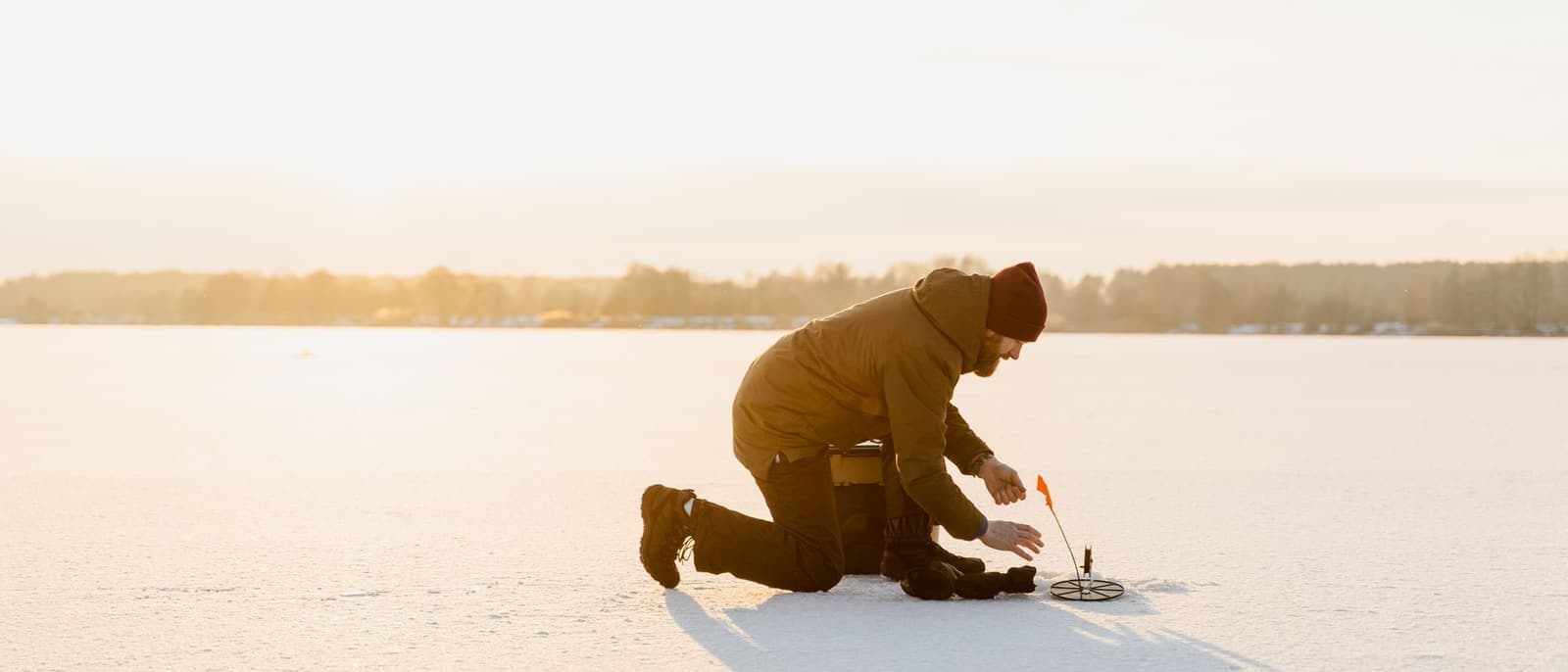
Buy the SNOW DEER waterproof heated mitten on the 3,000 mAh pack: it is the only option here that pairs a stated waterproof claim with the largest published energy budget in heated handwear, 22.2 watt-hours a hand. If you re-tie rigs constantly, buy the KastKing Calido convertible instead — its flip-top lets you bare your fingers for thirty seconds and put them back into a warm chamber, which no fixed glove can do.
Who each pick is for, in one line
- SNOW DEER waterproof mitten (3,000 mAh) — best for the angler who mostly sits and watches a rod. Waterproof claim plus the biggest published pack, and it publishes nothing else.
- TIDEWE heated gloves — best for the angler who wants numbers. The only glove here with watt-hours AND a temperature AND a runtime for all three settings, at the cost of a water-resistant rather than waterproof shell.
- KastKing Calido convertible mitten — best for anyone who ties their own rigs. A fishing brand's hinge, and no published energy figure at all.
- SAVIOR HEAT glove liners — best for the angler who already owns good waterproof fishing gloves. The cheapest route in, worn underneath.
- WASOTO heated mitten — best for anyone who wants to see the maker's own arithmetic. 22.2 Wh published as a multiplication, but splash-proof only.
Why water, not cold, is the problem on the ice
Air is a poor conductor of heat, which is the entire reason insulation works: trap air in fabric and you slow the rate at which your hand loses warmth. Water is a far better conductor than air — the usual figure quoted in cold-exposure literature is around twenty-five times better — so a wet glove is not a slightly worse glove, it is a fundamentally different one.
That matters more here than in any other use case on this site, because ice fishing wets your hands deliberately and repeatedly: pulling line, unhooking fish, re-baiting, scooping slush out of the hole. A glove that wets out at nine in the morning is not going to dry at minus ten, and every watt-hour you spend after that is heating water.
Quick picks
Tap any row to jump to the full write-up below. The energy column is the pack’s capacity times its voltage — the number this category does not print.
| # | Product | Best for | Energy | Price |
|---|---|---|---|---|
| 1 |  SNOW DEER Waterproof Heated Mittens, 7.4V 3000mAhThe same brand's bigger pack in a shell that claims to be waterproof rather than splash-proof — 22.2 Wh a hand instead… | A waterproof mitten on the larger pack | 22.2 Wh | $139.99View on Amazon |
| 2 |  TIDEWE Heated Hunting Gloves (two packs included)TIDEWE publishes the one number the rest of this category withholds — 22.2 Wh per hand — and then publishes a temperat… | The only heated glove here that publishes watt-hours | 22.2 Wh | $79.99View on Amazon |
| 3 |  KastKing Calido Convertible Heated MittensThe only heated handwear here designed by a fishing company for fishing: a flip-top mitten that opens to free your fin… | Bare fingers on demand without taking the heat off | — | $84.99View on Amazon |
| 4 |  SAVIOR HEAT Heated Glove LinersThe most underrated format in heated apparel: a thin heated liner under your existing work glove beats a bulky heated … | Keeping the gloves you already own | 16.3 Wh | $119.99View on Amazon |
| 5 |  WASOTO Heated Mittens (7.4 V, 22.2 Wh published)An unknown brand doing the thing this entire site exists to do for the makers who will not: WASOTO prints "7.4V*3000mA… | The only maker here that shows its own watt-hour arithmetic | 22.2 Wh | $109.99View on Amazon |
#ad — buy links are tagged and earn us a commission at no extra cost to you. Prices come from a live feed; where none is available the button reads “Check price” rather than showing a number we cannot stand behind. How we are funded.
SNOW DEER Waterproof Heated Mittens, 7.4V 3000mAh
The same brand's bigger pack in a shell that claims to be waterproof rather than splash-proof — 22.2 Wh a hand instead of 16.3, which is the single most useful upgrade available in heated handwear.
#ad Price as of October 23, 2026. How we are funded.
The numbers
- Energy
- 22.2 Wh
- Pack
- 7.4 V, 3,000 mAh per hand — 22.2 Wh, stated in the title
- Shape
- Mitten — fingers share one chamber
- Weather
- Waterproof, per the listing
- Screen use
- Touchscreen, per the listing
- Runtime
- Not published
- Heat zones
- Not stated on the listing
- Settings
- Not stated on the listing
- Care
- Not stated
On wattage: No wattage and no runtime published for this mitten, so the 22.2 Wh cannot be turned into hours. Figures circulate for other SNOW DEER mittens; we have not borrowed them for this one. What the energy DOES allow is a fair comparison: against WASOTO's inverted 3.1 W low setting on an identical 22.2 Wh pack, this mitten would run about seven hours — but that is WASOTO's draw, not SNOW DEER's, and we are not going to present it as if it were.
On the pack: 7.4 V and 3,000 mAh are both stated in the listing title, which gives 22.2 Wh per hand — 36% more energy than the 2,200 mAh packs SNOW DEER's other mitten and SAVIOR's whole extremity line run on. That is the difference between a long morning and a short one, and it is the only figure here that is published.
What we like
- 22.2 Wh per hand — the larger of the two pack sizes this brand sells, and the figure is in the title
- A waterproof claim rather than a water-resistant one, which matters more at a fishing hole than anywhere else
- Mitten geometry, which keeps fingers warmer than a glove at any given power
- Touchscreen-compatible, so the phone does not cost you a bare hand
- Room inside for a thin liner, which is the cheapest way to extend any mitten
What we do not
- Publishes the battery and nothing else — no runtime, no settings count, no element layout, no temperatures
- No wattage, so the 22.2 Wh cannot be converted into hours by us or anyone else
- Costs meaningfully more than the brand's 2,200 mAh mitten for an undocumented amount of extra heat
- A mitten has no dexterity; it comes off for anything fiddly
- The waterproof claim is the listing's, with no rating behind it
Who this suits
An ice angler, a spectator or anyone stationary in wet cold who wants the biggest pack in a mitten and can live without a runtime figure.
Who should skip it
You want to plan a day around a number. This listing gives you the energy and refuses to tell you how fast it leaves.
Spec sources: Amazon — SNOW DEER heated mittens, waterproof, touchscreen, "7.4V 3000mAh Battery" stated in the listing title (22.2 Wh per hand by conversion). The listing states the voltage and the capacity and nothing else that bears on power. · Amazon — SNOW DEER 7.4V 2200mAh replacement pack
TIDEWE Heated Hunting Gloves (two packs included)
TIDEWE publishes the one number the rest of this category withholds — 22.2 Wh per hand — and then publishes a temperature and a runtime for all three settings, which lets you check the claim instead of taking it.
#ad Price as of October 23, 2026. How we are funded.
The numbers
- Energy
- 22.2 Wh
- Maker's stated energy
- 22.2 Wh per hand
- Pack
- 7.4 V, two supplied
- Shell
- Seven-layer, 3M insulation, 140 GSM water-resistant coating
- Claims
- All three settings, with temperatures
- Heat zones
- Not specified by TIDEWE beyond the heated glove body
- Settings
- Three
- Care
- Not stated by TIDEWE
On wattage: No wattage published, but with three claims and a real watt-hour figure the draw can be inverted three ways instead of guessed once. The high-setting claim implies about 6.3 W per hand at the optimistic end of the range and 8.9 W at the pessimistic end.
On the pack: 22.2 Wh at 7.4 V is 3,000 mAh, one pack per hand. Publishing the figure in watt-hours rather than milliamp-hours is the honest way round, because watt-hours is the number that actually compares across voltages.
What we like
- Publishes energy in watt-hours, which nothing else in this category does
- A temperature AND a runtime for every setting, so the claim can be inverted
- Seven-layer shell with 3M insulation does real work before the element is on
- Two packs in the box rather than one
What we do not
- No wattage published, so the draw is still inferred rather than read
- TIDEWE does not state where the elements sit inside the glove
- No published care instructions
- Bulkier than a liner, which matters if you need to work a trigger or a zip
Who this suits
A hunter or an angler who is stationary in the cold and wants a claim that can be checked.
Who should skip it
You need dexterity more than heat. A liner under your own glove keeps the feel that a shell this thick removes.
Spec sources: TIDEWE — heated hunting gloves (7.4 V, 22.2 Wh, with a temperature and runtime published for all three settings)
KastKing Calido Convertible Heated Mittens
The only heated handwear here designed by a fishing company for fishing: a flip-top mitten that opens to free your fingers for a knot and closes again without coming off — which is the actual problem on the ice, and not one a spec sheet solves.
The numbers
- Energy
- Not derivable — 3,000 mAh with no published voltage
- Format
- Convertible — flip-top mitten that opens to free the fingers
- Weather
- Water-resistant, per the listing
- Intended use
- Ice fishing, named on the listing by the maker
- Heat zones
- Not stated by KastKing
- Settings
- Three, per the listing — no temperatures published
- Care
- Not stated
On wattage: Not published, and not derivable, because the watt-hours are not derivable either. Third-party listings do circulate temperatures and runtimes for this mitten and they contradict each other on both the high and low temperature, so none of them are quoted here. Buy this for the hinge, not for the numbers.
On the pack: KastKing states "3000mAh" and never states a voltage. At 3.7 V that is about 11.1 Wh a hand; at 7.4 V about 22.2 Wh. Those are different products and we are not going to choose one and present it as a specification. KastKing publishes no spec page for the Calido heated mittens on its own site — the only convertible mitten there is the unheated PolarBlast — so there is nowhere to resolve it. The brand that makes the most purpose-built product on this page documents it the least.
What we like
- The flip-top hinge is the one feature on this page that addresses the real problem: you can bare your fingers for thirty seconds and put them back into a warm chamber, instead of taking a glove off and losing the heat
- Designed and sold by a fishing brand for ice fishing rather than adapted from a ski glove
- Mitten geometry when it is closed, which is the warmest shape per watt-hour
- The lowest price of the mittens on this page
What we do not
- No voltage published, so the energy — the only figure that compares fairly across brands — cannot be calculated at all
- No wattage, no temperatures and no runtime published by KastKing
- No specification page on kastking.com for this product, so there is nothing to check the listing against
- Water-resistant, not waterproof — and on the ice that distinction is the whole game
- The hinge is one more seam and one more failure point than a plain mitten has
Who this suits
An ice angler who ties their own rigs and would rather have a hinge than a spec sheet.
Who should skip it
You want to know what you are buying in energy terms. A capacity with no voltage is a large number, not a specification.
SAVIOR HEAT Heated Glove Liners
The most underrated format in heated apparel: a thin heated liner under your existing work glove beats a bulky heated glove for anyone who has to actually use their hands.
#ad Price as of October 23, 2026. How we are funded.
The numbers
- Energy
- 16.3 Wh
- Pack
- 7.4 V, 2,200 mAh per hand
- Thickness
- Liner — fits inside a work or ski glove
- Touchscreen
- Yes, per the listing
- Heat zones
- Back of hand and fingers
- Settings
- Three
- Care
- Hand wash with the battery out
On wattage: No published wattage. Small packs and a small element area, so the runtime spread between settings is wide.
On the pack: Liner packs in this class are 7.4 V, 2,200 mAh. The capacity is stated on the replacement-pack listing rather than on the glove listing.
What we like
- Fits under gloves you already trust, so you keep your grip and your dexterity
- Cheapest route into heated hands by a wide margin
- Packs are small enough to live in a coat pocket
What we do not
- Smallest packs here — about 16 Wh a hand, and the arithmetic on that is unforgiving
- No wind or water protection of their own
- The fit under a tight glove can be a squeeze
Who this suits
Trades workers, photographers, anyone who has to do something with their fingers in the cold.
Who should skip it
You want long runtime. This is the smallest energy budget on the site and it shows.
Spec sources: Amazon — SNOW DEER 7.4V 2200mAh replacement pack
WASOTO Heated Mittens (7.4 V, 22.2 Wh published)
An unknown brand doing the thing this entire site exists to do for the makers who will not: WASOTO prints "7.4V*3000mAh=22.2Wh" on its own product page, then publishes a temperature AND a runtime band for all three settings.
The numbers
- Energy
- 22.2 Wh
- Maker's stated energy
- 22.2 Wh per hand — published as "7.4V*3000mAh=22.2Wh"
- Element coverage
- Back of hand and fingers
- Claims
- A temperature AND a runtime band for all three settings
- In the box
- Two packs plus an 8.4 V dual charger
- Weather
- Twill described as splash-proof and windproof — no waterproof rating
- Heat zones
- A "composite fiber heating pad" across the back of the hand AND the fingers, per WASOTO. The palm is not listed as heated.
- Settings
- Three, published with a temperature range for each
- Care
- Not stated. A laundry bag is in the box, which implies washing is intended, but WASOTO publishes no instructions
On wattage: No wattage published, but with a real watt-hour figure and three runtime bands the draw inverts three ways and the answers agree with each other. Taking the midpoint of each band against 22.2 Wh: about 7.4 W on high (3 h), 5.6 W on medium (4 h) and 3.1 W on low (7.25 h). That is a smooth 2.4x ladder from one pack, which is the shape of a calculated spec sheet rather than an invented one. The pessimistic ends of the bands give 6.3 W / 4.9 W / 2.8 W — a narrower spread than the single-figure claims most of this category publishes.
On the pack: 22.2 Wh per hand, published as watt-hours by the maker and checkable against its own capacity and voltage. Two packs and an 8.4 V dual charger are in the box, so there is no second purchase to make the mittens work. The batteries are described as UL, FCC and CE certified — a named standard rather than the words "certified safe".
What we like
- Publishes the watt-hour conversion as arithmetic on its own page, which no established brand on this site does
- A temperature range AND a runtime band for every setting, so the draw can be inverted three ways
- 22.2 Wh a hand is the top of the range this category offers, 36% more than the 2,200 mAh packs
- Element across the fingers as well as the back of the hand
- Two packs and the charger included, and the cells carry UL, FCC and CE
What we do not
- The Amazon listing title says "Waterproof". WASOTO's own page claims only "splash-proof and windproof" and lists the materials as twill, microfiber and velvet — do not take it ice fishing expecting a membrane
- No wattage published, so the draw is still inverted rather than read
- No warranty and no washing instructions published, on a garment sold with a laundry bag
- No charge time published for a pair of 3,000 mAh packs
- An unknown brand with no service history, and the "Shop on Amazon" button on its own site points at Alibaba
- A mitten, so you cannot do anything precise in them
Who this suits
Someone who wants the largest published energy budget per hand in a mitten and would rather buy from the maker that documents its product than the one with the familiar name.
Who should skip it
You need a waterproof shell or a warranty you can call on. The energy figures are the best here; the brand assurances are the thinnest.
The energy figures, and the one that is missing
Three of the five picks here carry 22.2 watt-hours a hand, which is the top of the range this category offers and 36% more than the 2,200 mAh packs that most heated gloves and mittens have run on since this site launched. That is a real improvement and it is worth paying for.
Watt-hours, and what they buy
Energy is capacity times nominal voltage. The ceiling draw is the pack’s own published output current times its voltage. The implied draw runs the maker’s advertised hours backwards. Nothing here is measured — check our working.
| Product | Capacity | Volts | Energy | Ceiling draw | Shortest runtime | Implied draw at the claim |
|---|---|---|---|---|---|---|
| SNOW DEER Waterproof Heated Mittens, 7.4V 3000mAh | 3,000 mAh | 7.4 V | 22.2 Wh | Not published | Not derivable | No claim published |
| TIDEWE Heated Hunting Gloves (two packs included) | 3,000 mAh | 7.4 V | 22.2 Wh | Not published | Not derivable | 6.3 Wat 3.5 h high, 140-149°f |
| SAVIOR HEAT Heated Glove Liners | 2,200 mAh | 7.4 V | 16.3 Wh | Not published | Not derivable | No claim published |
| WASOTO Heated Mittens (7.4 V, 22.2 Wh published) | 3,000 mAh | 7.4 V | 22.2 Wh | Not published | Not derivable | 7.4 Wat 3 h high, 140-149°f |
“Not derivable” means the manufacturer does not publish the figure the sum needs. We leave it blank rather than estimating it, borrowing a number from a similar model, or rounding one into existence. These are ceilings, not promises: cold, wind, movement and pack age all push real runtime below them. Run your own numbers.
The empty row is the finding. KastKing — the fishing brand, the one that actually designed its product for this use — publishes a capacity of 3,000 mAh and no voltage anywhere, and has no specification page for the Calido heated mittens on its own website. At 3.7 V that capacity is about 11 watt-hours a hand; at 7.4 V it is about 22. Those are different products, and we are not going to pick one and present it as a fact. Meanwhile WASOTO, a brand nobody has heard of, prints the multiplication on its own page.
Mitten or glove, for a day on the ice
Mitten, for the waiting. Four fingers in one chamber present far less surface area to the cold than four fingers in four separate tubes, and they warm each other instead of each fighting alone. At a fixed watt-hour budget that geometry is free warmth, which is why heated mittens beat heated gloves wherever you can tolerate them.
The problem is that ice fishing does not let you tolerate them for long. Tying a jig to 4 lb fluorocarbon is a fingertip task, and a mitten comes off to do it. Every time it comes off, the warm chamber you have spent twenty minutes of battery building vents to the air, and your hand goes back into a cold mitten.
That is the specific problem the convertible solves, and it is why a flip-top mitten from a fishing company earns a place on this page despite publishing less about itself than anything else here. The hinge is not a gimmick; it is the difference between a mitten you wear and a mitten in your bucket.
What to do about the battery pockets
Every 7.4 V option here clips its pack at the wrist or inside the cuff, which is where water runs down when you lift a hand out of a hole. Not one maker on this page publishes an ingress rating for the pack or its pocket — not the waterproof mitten, not the water-resistant glove, not the one with the hinge.
So the honest advice is procedural rather than product-based: keep a charged spare in an inside jacket pocket where your body heat keeps it near its rated capacity, and treat a pack that has been soaked as suspect rather than as a spare. Spare and replacement batteries covers what a second pack costs across the brands here, and charging and care covers why a cold pack reports less than it holds.
Your feet will go before your hands do
Worth saying on a gloves page, because it is the most common mistake in this use case. You are sitting still on a bucket, on ice, for hours. Your feet are in contact with a surface that is by definition at or below freezing and they are not moving, which is a worse situation than your hands are in.
If you are buying once, buy for the feet first: heated socks for hunting covers the same long-motionless-sit problem, and heated insoles for hunting measures the published runtimes against the length of an actual sit. A heated vest under your bibs does more for cold hands than most people expect, too, because your body restricts blood flow to the extremities to protect core temperature — jacket or vest explains why the vest is usually the right one.
What we would skip, and why
- Any glove whose only water claim is "water-resistant"
- On a ski slope water-resistant is usually enough, because the water arrives as snow and brushes off. At a hole in the ice it arrives as liquid, repeatedly, directly onto the glove, and a resistant shell wets out. Once the insulation is wet it has stopped insulating and the element is heating water instead of your hand. This is the one use case where we would pay more for a stated waterproof claim than for extra watt-hours.
- Thin heated liners worn as your outer glove
- Liners are on this page because they are the cheapest way into heat and they go under gloves you already trust. Worn as the outer layer on the ice they have no membrane at all, and the first wet jig ends them for the day. Buy them to go inside a waterproof fishing glove, not instead of one.
- Heated gloves with a battery pocket on the cuff, if you fish bare-handed a lot
- Every 7.4 V glove here clips its pack at the wrist, which is exactly where water runs when you lift a hand out of a hole. None of the makers publish an ingress rating for the pack pocket specifically, so we cannot tell you which ones handle it. What we can say is that this is the component you should keep an eye on, and that a cheap spare pack is worth having in an inside pocket.
- Fingerless or flip-finger designs with no heated chamber to flip back into
- A convertible only helps if the closed position is a genuinely warm mitten. Half-finger heated gloves exist and they are the worst of both: no dexterity gain worth having, and the fingertips — the part that actually goes numb — are outside the element.
Our criteria, and what we did not do
- A stated waterproof claim ranked above everything else, because on the ice a wet glove is a dead glove whatever its battery holds.
- Published pack capacity AND voltage, converted at nominal voltage. Where a maker states a capacity and no voltage, we mark the energy not derivable rather than guessing which one it meant.
- Mitten geometry preferred over fingers for the waiting, since four fingers sharing one chamber lose less heat than four in separate tubes.
- A way to free your fingers without taking the glove off, weighted heavily — re-tying is the task that actually makes people give up on heated handwear.
- Spare-pack availability, because a day on the ice is longer than any 22 Wh pack.
- We have not worn any of these, and we have not fished in them. How we work.
We have not worn, tested or owned any of these products, and we say so on every page rather than in a footer. What we do instead is compile the published specifications and do the arithmetic. The full method.
The recommendation
Buy the waterproof mitten on the larger pack if your day is mostly sitting. Buy the convertible if your day is mostly fiddling. If you already own fishing gloves you trust in the wet, buy liners to go inside them and spend the difference on a spare pack and something for your feet.
Frequently asked
- Do heated gloves work for ice fishing?
- Yes, with one condition: the shell has to keep liquid water out. Ice fishing wets your hands deliberately and repeatedly, water carries heat away from skin roughly twenty-five times faster than air does, and a heated glove that has wetted out is heating water rather than your hand. Buy the stated waterproof claim first and compare the batteries second.
- Are heated mittens or heated gloves better for ice fishing?
- Mittens for the waiting, gloves if you re-tie constantly. Fingers sharing one chamber lose less heat than fingers in separate tubes, so a mitten gets more warmth out of the same watt-hours. The catch is that tying a jig means the mitten comes off and the chamber you spent twenty minutes heating vents. A convertible flip-top is the compromise that actually works.
- How long do heated gloves last ice fishing?
- Less than the box says, and less than the arithmetic says. The largest packs here hold 22.2 watt-hours a hand, which runs about seven hours at the low draw one maker's own figures imply and about three on high. Cold reduces what a lithium pack delivers, and a wet glove raises the heat loss the element is fighting, so plan on a charged spare rather than a single pack.
- What is the biggest battery in a heated glove or mitten?
- Among the options we can verify, 3,000 mAh at 7.4 V — 22.2 watt-hours per hand. That is the figure SNOW DEER states in its waterproof mitten's listing title, TIDEWE publishes directly as watt-hours, and WASOTO prints as a multiplication on its own page. It is about 36% more energy than the 2,200 mAh packs most heated handwear uses.
- Should I buy heated gloves or heated socks for ice fishing?
- Socks or insoles first, if you are buying once. You are stationary on a frozen surface for hours, which is a harder problem for your feet than for your hands, and your body restricts blood flow to the extremities when your core cools — so warming your core and your feet improves your hands indirectly as well.
Sources
- Amazon — SNOW DEER waterproof heated mittens, "7.4V 3000mAh Battery" stated in the listing title (22.2 Wh per hand by conversion)
- Amazon — KastKing Calido Convertible Heated Mittens, "3000mAh ... Ice Fishing Gloves, Flip Mittens, Water-Resistant" — the listing title is the whole published specification; no voltage is stated
- WASOTO — WM001 Classic Heated Mittens, the only maker page we have fetched that prints the conversion itself: "7.4V*3000mAh=22.2Wh", with three temperature ranges and three runtime bands
- TIDEWE — heated hunting gloves (22.2 Wh per hand published, plus a temperature and a runtime for all three settings)
Related

Heated Gloves
The smallest packs in heated apparel, fighting the worst heat loss on the body. Liners are the underrated answer.
Heated gloves for hunting, where stillness is the whole problem
Hours of stillness, then one moment that needs fingers. Why a liner under a shed-able mitten beats any single glove, and which brand publishes enough to check.
Heated gloves or heated mittens?
One maker's gloves against its own mittens, same voltage and same pack, so the only variable is the shape. Mittens win on warmth, gloves win on getting worn.

Heated socks for hunting, where the sit is longer than the pack
Sixteen watt-hours a foot against a four-hour sit. How to ration it, and the boot-fit trap that ruins most attempts.
Heated insoles for hunting, measured against the length of an actual sit
A sit is ten hours; the published top-setting runtimes are three to five. Exactly one insole clears a full day, and the insole you were sold often carries less energy than a sock.
Can you wear heated clothing in the rain?
Three of 78 garments say waterproof and none publish a rating. Why the fabric is not the weak point, what to do about the battery pocket, and the layering order that works in wet cold.
Spare and replacement batteries, converted before you buy
A second pack is the cheapest real upgrade here. Every capacity claim converted to watt-hours, with the airline band attached — including the class that quietly stops being carry-on legal.
Heated gloves for snowmobiling, where mittens beat gloves and grips beat neither
Your sled already heats your palms. The wind works on the back of your hand. Why mittens win here and lose on a motorcycle, with the watt-hours converted.