How long does a heated jacket battery actually last?
Every brand publishes an hours figure. Convert them all to watts and it becomes obvious that 'low' is not a standard — it varies nearly threefold between makers.
By Scooter M. · Published September 9, 2026
How this is funded: buy links here are tagged and earn us a commission at no extra cost to you. It does not affect what we recommend, and we take no free product and no sponsorship. Read the disclosure.
On the highest setting, roughly two to three hours for a standard consumer pack — and almost nobody publishes that figure. What brands publish is a low-setting number, and 'low' is not a standard: converted to watts, one brand's low draws 1.8 W and another's draws 4.9 W. That is why the advertised hours cannot be compared across makers.
The question everyone asks, and why the answers do not line up
Search for how long any heated garment lasts and you will get a number from every manufacturer. ORORO says up to 10 hours. Milwaukee says up to 12. DEWALT says 5.5. Venustas says 10. Those figures look comparable and are not, because each one describes a different amount of heat.
The missing variable is draw. A runtime figure is only meaningful alongside the wattage it assumes, and no maker in this category publishes wattage. So the only way to compare brands is to recover the draw from the two numbers they do publish — capacity and hours — and put those side by side.
Every brand's claim, converted
| Garment | Pack | Energy | Maker's claim | Implied draw |
|---|---|---|---|---|
| Milwaukee 3-zone jacket (TOUGHSHELL, AXIS) | M12 2.0 Ah | 21.6 Wh | 12 h low / 6 h med / 3 h high | 1.8 / 3.6 / 7.2 W |
| Milwaukee 2-zone vest and hoodie | M12 2.0 Ah | 21.6 Wh | 8 h low / 4 h med / 2 h high | 2.7 / 5.4 / 10.8 W |
| ororo soft shell jacket, lightweight vest | B19G 5,200 mAh | 38.5 Wh | 8-10 h low / 5-6 med / 2-3 high | 4.3 / 7.0 / 15.4 W |
| ororo PD 5K pack | 5,075 mAh | 37.6 Wh | Up to 10 h | 3.8 W |
| ororo PD 10K pack | 10,150 mAh | 75.1 Wh | Up to 17 h | 4.4 W |
| DEWALT soft shell jacket *(overview text)* | 20V MAX 1.5 Ah | 27.0 Wh | Up to 5.5 h low | 4.9 W |
| DEWALT soft shell jacket *(features text, same page)* | 20V MAX 1.5 Ah | 27.0 Wh | Up to 7 h low | 3.9 W |
| Venustas heated jacket | 7.4 V, capacity not published | Not derivable | Up to 10 h, no setting stated | Not derivable |
Converted at nominal voltage: M12 at 10.8 V and DEWALT 20V MAX at 18 V, not the figures on the labels. Sources for every claim are listed at the foot of this page.
Finding one: 'low' varies by nearly three times
Sort that table by implied low-setting draw and the spread is the story:
| Brand and garment | Implied draw on low |
|---|---|
| Milwaukee, 3-zone jacket | 1.8 W |
| Milwaukee, 2-zone vest and hoodie | 2.7 W |
| ororo, PD 5K pack | 3.8 W |
| DEWALT, jacket (on its 7-hour claim) | 3.9 W |
| ororo, standard apparel pack | 4.3 W |
| DEWALT, jacket (on its 5.5-hour claim) | 4.9 W |
A 2.7x spread between the lowest and the highest.
That is the whole reason cross-brand runtime comparison does not work. Milwaukee's twelve hours and DEWALT's five and a half are not describing the same product doing the same thing for different lengths of time. They are describing two garments running at very different outputs, and the longer figure belongs to the one producing less heat.
It also inverts the instinct that a bigger number is better. Milwaukee's three-zone jacket posts the longest low-setting claim in the table on the smallest battery in the table — because it draws the least. If what you want is warmth rather than duration, the long number is the warning sign, not the selling point.
Quick picks
Tap any row to jump to the full write-up below. The energy column is the pack’s capacity times its voltage — the number this category does not print.
| # | Product | Best for | Energy | Price |
|---|---|---|---|---|
| 1 |  ororo Men's Soft Shell Heated JacketThe clearest power story in the category: ororo publishes capacity and voltage for every pack it sells, so you can wor… | A first heated jacket | 38.5 Wh | $159.99View on Amazon |
| 2 | 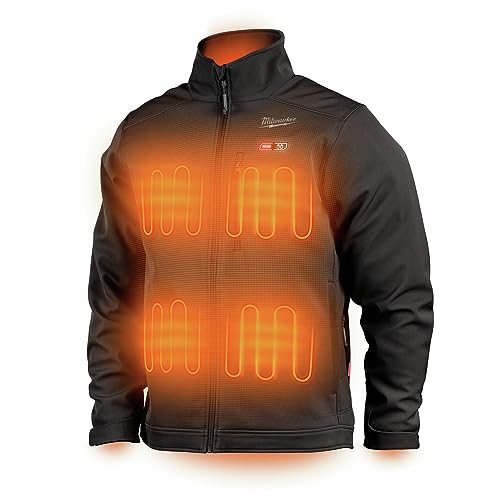 Milwaukee M12 Heated TOUGHSHELL Jacket (204B-20)Built like site clothing rather than outerwear, and the only jacket here whose battery you can swap in seconds because… | Anyone already on M12 | 21.6 Wh | $219.00View on Amazon |
| 3 |  ororo PD 7K Rechargeable Battery for Heated Apparel7,000 mAh of LG cells with a published 13.5-hour claim and a six-mark certification list — the biggest step up availab… | The largest ororo pack you can actually buy | 51.8 Wh | $89.99View on Amazon |
| 4 |  Milwaukee M12 Heated AXIS VestTwo zones instead of the jacket's three, and Milwaukee's own numbers say it runs out in a third of the time — which is… | The hottest thing in the M12 line | 21.6 Wh | $279.00View on Amazon |
| 5 |  Venustas Unisex Dual-Control Heated JacketMore heating elements than anything else at the price, which cuts both ways: the same pack energy is divided further, … | Most heating zones for the money | 37.0 Wh | $139.99View on Amazon |
#ad — buy links are tagged and earn us a commission at no extra cost to you. Prices come from a live feed; where none is available the button reads “Check price” rather than showing a number we cannot stand behind. How we are funded.
ororo Men's Soft Shell Heated Jacket
The clearest power story in the category: ororo publishes capacity and voltage for every pack it sells, so you can work out what you are getting instead of taking a marketing number on faith.
The numbers
- Energy
- 38.5 Wh
- Pack
- 7.4 V, 5,200 mAh (ororo B19G)
- Published output
- 2.5 A
- Heat zones
- 3
- Maker's runtime claim
- 8-10 h low / 5-6 h medium / 2-3 h high
- Heat zones
- Left and right chest, mid-back
- Settings
- Three, cycled from a single chest button
- Care
- Machine washable with the battery removed
On wattage: ororo publishes no wattage for the garment. It does publish hours for each of the three settings, which states the draw whether it meant to or not.
What we like
- ororo publishes capacity AND voltage for every pack, which almost nobody else in this category does
- Per-setting runtime claims rather than one 'up to' number, so the low-to-high spread is visible before you buy
- Soft-shell cut layers under a work coat without bulk
What we do not
- No published wattage for the garment itself
- Three zones only — nothing at the arms or the kidneys
- The headline runtime figure is the low setting, as it is everywhere
Who this suits
Someone standing still outdoors for two to four hours at a stretch who wants the power figures on the table before buying.
Who should skip it
You need heat for a full eight-hour shift on high. No 38 Wh pack does that, and this one does not claim to.
Spec sources: ororo — Heated Apparel Battery Guide (capacity, voltage and output for every pack) · Amazon — ororo 7.4V 5200mAh battery listing (per-setting runtime claim)
Milwaukee M12 Heated TOUGHSHELL Jacket (204B-20)
Built like site clothing rather than outerwear, and the only jacket here whose battery you can swap in seconds because you already own four of them.
#ad Price as of October 17, 2026. How we are funded.
The numbers
- Energy
- 21.6 Wh
- Pack
- M12 REDLITHIUM CP2.0, 2.0 Ah
- Voltage used here
- 10.8 V nominal (marketed as 12 V)
- Heat zones
- 3
- Maker's runtime claim
- 12 h low / 6 h medium / 3 h high
- Heat zones
- Chest, back and hand pockets
- Settings
- Three, plus a preheat cycle
- Care
- Machine washable with the battery removed
On wattage: Milwaukee publishes run-time, not watts — but it publishes all three settings, which is more than most of this category manages. The 12/6/3 pattern is a clean doubling of draw at each step. Milwaukee does not state which M12 pack those hours assume, so the resulting wattage is a shape rather than a fixed figure.
On the pack: Sold bare. The live listing title reads "Jacket Only" — no pack and no charger in the box. That is the right buy if you already run M12 and the wrong one if you do not. See [which garments include a battery](/battery/battery-included-or-separate).
What we like
- Hot-swappable packs — the only real answer to a short runtime is a second battery, and you already have one
- Genuinely durable shell fabric, built for work rather than for a catalog photo
- The pack doubles as a tool battery, so nothing in the van is single-purpose
What we do not
- The 2.0 Ah pack is small by heated-apparel standards once you convert it honestly
- Jacket-only SKUs ship without a battery, which is easy to miss at checkout
- Heavier than a soft-shell layer
Who this suits
A trades worker with an M12 kit already in the van, for whom a spare pack costs nothing extra to carry.
Who should skip it
You own no M12 tools. Buying into a tool platform for one jacket is the most expensive route into heated clothing.
Spec sources: Milwaukee Tool — M12 REDLITHIUM CP2.0 battery, 12V 2.0Ah · Milwaukee Tool — M12 Heated Jacket Kit (up to 8 hours on the REDLITHIUM 2.0) · Milwaukee Tool — M12 Heated TOUGHSHELL jacket kit
ororo PD 7K Rechargeable Battery for Heated Apparel
7,000 mAh of LG cells with a published 13.5-hour claim and a six-mark certification list — the biggest step up available to an ororo owner, because the larger PD 10K is not sold through this retailer.
#ad Price as of October 17, 2026. How we are funded.
The numbers
- Energy
- 51.8 Wh
- Capacity
- 7,000 mAh at 7.27 V — about 50.9 Wh
- Published output
- 30 W out, up to 24 W in
- Recharge
- Fully recharged within 3 hours
- Certification
- UL2056, CE, FCC, CB, WEEE, CA65 per ororo
- Heat zones
- Not applicable — this is a battery
- Settings
- Garment-dependent
- Care
- Not washable — remove before laundering the garment
On wattage: No garment wattage is published, but this pack states its own delivery figures: "up to 24W input" and "30W output". The 30 W output is a ceiling for charging devices rather than a figure any ororo garment draws — inverting the 13.5-hour claim against about 50.9 Wh gives roughly 3.8 W, which is the draw that claim actually assumes.
On the pack: Worth reading the voltage twice. This pack's own product page gives "7.27V", while ororo's battery guide lists the PD 7K at 7.4 V. At 7.27 V the 7,000 mAh works out to about 50.9 Wh; at 7.4 V it is 51.8 Wh. We use the figure printed on the product page itself and note the 2% disagreement rather than quietly picking the flattering one.
What we like
- The largest ororo pack actually purchasable here — roughly 43% more energy than the Mini 5K that ships with several ororo garments
- ororo publishes a real certification list, with UL2056 printed on the casing
- USB-C in and out at 30 W means it doubles as a fast phone bank
- Three-hour full recharge is quick for this capacity
What we do not
- ororo's own two pages disagree on the voltage — 7.27 V on the product page, 7.4 V in the battery guide
- No watt-hour figure printed for this pack, unlike ororo's Mini 5K and PD 5K pages
- The larger PD 10K exists in ororo's lineup but is not sold through this retailer
- Costs a meaningful fraction of a whole garment, which is the usual complaint about spare packs
Who this suits
An ororo owner whose garment shipped with a Mini 5K and who has discovered that the battery, not the jacket, is what ends their day.
Who should skip it
Your garment already ships a PD 5K or larger and your days are short. The jump from 37.5 Wh to 50.9 Wh is real but it is not transformative.
Spec sources: ororo — 7000 mAh PD 7K Rechargeable Battery ("7,000mAh" with "premium LG cells"; voltage given as "7.27V" on this page against 7.4 V in ororo's battery guide; "up to 24W input"; "30W output"; "fully recharged within 3 hours"; "up to 13.5 hours of heat"; "UL2056, CE, FCC, CB, WEEE, CA65 certified"; "1 USB-C Port, 1 USB-C Cable, 1 DC Port"; NTC sensor) · ororo — Heated Apparel Battery Guide (capacity, voltage and output for every pack)
Milwaukee M12 Heated AXIS Vest
Two zones instead of the jacket's three, and Milwaukee's own numbers say it runs out in a third of the time — which is the tell that its elements pull harder. If you want heat rather than hours, this is the M12 garment that delivers it.
#ad Price as of October 17, 2026. How we are funded.
The numbers
- Energy
- 21.6 Wh
- Pack
- Any M12 pack; kits ship with a 2.0 Ah
- Heat zones
- 2
- Maker's runtime claim
- 8 h low / 4 h medium / 2 h high
- Implied draw on a 2.0 Ah
- ~2.7 W / ~5.4 W / ~10.8 W
- Heat zones
- Chest and back
- Settings
- Three, per zone, from a one-touch LED controller
- Care
- Machine washable with the battery removed
On wattage: Milwaukee publishes no wattage, but it publishes hours for all three settings — and the 8/4/2 pattern is a clean doubling of draw at each step. On a 2.0 Ah pack that inverts to roughly 2.7 W, 5.4 W and 10.8 W. Milwaukee does not state which pack those hours assume, so treat them as a shape rather than a fixed figure.
What we like
- The shortest claimed high-setting runtime in the M12 line, which on fixed pack energy is the arithmetic signature of the most heat
- A vest layers under the work coat you already own, so your coat does the insulating and the battery only tops up
- Runs off the same packs as your tools — the runtime problem becomes a ten-second swap
What we do not
- Two hours on high is genuinely short, and it is Milwaukee's own figure rather than our estimate
- No wattage published, and no pack named for the runtime claims
- Two zones means nothing at the shoulders, which the AXIS jacket does cover
Who this suits
Someone on M12 who is cold rather than impatient — standing still in hard cold, with spare packs in the van and a coat to wear over it.
Who should skip it
You want to set it and forget it for a shift. On high this is a two-hour garment by Milwaukee's own reckoning, and no amount of layering changes that.
Spec sources: Milwaukee Tool — M12 Heated Gear line (per-setting run-time and heat zones for every garment) · Milwaukee Tool — M12 REDLITHIUM CP2.0 battery, 12V 2.0Ah
Venustas Unisex Dual-Control Heated Jacket
More heating elements than anything else at the price, which cuts both ways: the same pack energy is divided further, and Venustas does not publish the wattage that would tell you by how much.
The numbers
- Energy
- 37.0 Wh
- Pack
- 7.4 V (capacity varies by SKU)
- Heat zones
- 6
- Maker's runtime claim
- Up to 10 h, setting unspecified
- Controls
- Two independent circuits
- Heat zones
- Neck, left and right chest, mid-back, both hand pockets
- Settings
- Three, with the upper and lower circuits controlled separately
- Care
- Machine washable with the battery removed
On wattage: No published wattage. One 'up to 10 hours' figure with no setting attached, which is the least informative form the claim can take.
On the pack: Venustas ships a 7.4 V pack and advertises up to 10 hours. The capacity varies by SKU and is not published consistently, so treat the watt-hour figure here as approximate and check the listing for the pack you are actually buying.
What we like
- Dual control is genuinely useful — pocket heat is what you want standing still, core heat is what you want moving
- Six zones reach the neck, which most three-zone jackets leave cold
- Detachable hood, so it layers under a shell
What we do not
- No published wattage and no per-setting runtime, so the power story is one unqualified number
- Pack capacity is not stated consistently across SKUs sold under similar names
- More zones on the same pack is not more heat — it is the same heat spread thinner
Who this suits
Someone who wants pocket heat and core heat on separate switches and is buying on coverage rather than runtime.
Who should skip it
You want to know what you are buying in watt-hours before you buy it. On this jacket you cannot, and we are not going to pretend otherwise.
Spec sources: Venustas — heated jacket collection
Finding two: DEWALT's own page publishes two different answers
This one is worth seeing because it shows how firm these figures actually are. On DEWALT's product page for the 20V MAX soft shell heated jacket, the overview section states up to 5.5 hours of runtime on the low setting using the 20V MAX compact 1.5 Ah battery. The features section on the same page, for the same jacket and the same battery, states up to 7 hours.
Both cannot be right. Converted, they imply 4.9 W and 3.9 W respectively — a 27% disagreement about how much heat the jacket makes on its lowest setting, inside a single page.
Finding three: almost nobody publishes the setting you will actually use
Of everything in the table, exactly one maker publishes runtime for all three settings on every garment: Milwaukee. ORORO publishes a range across its three settings on its battery listings. DEWALT publishes low only. Venustas publishes one number with no setting attached at all.
That matters because the low setting is not why anyone buys a heated jacket. You switch it on because you are cold, which means you reach for medium or high — and for most of this category, the manufacturer has published nothing about what happens then.
Where a maker does publish it, the numbers are sobering. ORORO's own high-setting claim works out to 15.4 W, which empties its 38.5 Wh pack in about two and a half hours. Milwaukee's two-zone vest implies 10.8 W on high, which is two hours on a 21.6 Wh pack. Those are the honest answers to the question in this page's title, and they are roughly a fifth of the headline figures.
Watt-hours, and what they buy
Energy is capacity times nominal voltage. The ceiling draw is the pack’s own published output current times its voltage. The implied draw runs the maker’s advertised hours backwards. Nothing here is measured — check our working.
| Product | Capacity | Volts | Energy | Ceiling draw | Shortest runtime | Implied draw at the claim |
|---|---|---|---|---|---|---|
| ororo Men's Soft Shell Heated Jacket | 5,200 mAh | 7.4 V | 38.5 Wh | 18.5 W | 2h 05m | 15.4 Wat 2.5 h high |
| Milwaukee M12 Heated TOUGHSHELL Jacket (204B-20) | 2,000 mAh | 10.8 V | 21.6 Wh | Not published | Not derivable | 7.2 Wat 3 h high |
| ororo PD 7K Rechargeable Battery for Heated Apparel | 7,000 mAh | 7.4 V | 51.8 Wh | 22.2 W | 2h 20m | 3.8 Wat 13.5 h maker's headline claim, with ororo apparel |
| Milwaukee M12 Heated AXIS Vest | 2,000 mAh | 10.8 V | 21.6 Wh | Not published | Not derivable | 10.8 Wat 2 h high |
| Venustas Unisex Dual-Control Heated Jacket | 5,000 mAh | 7.4 V | 37.0 Wh | Not published | Not derivable | 3.7 Wat 10 h maker's headline claim |
“Not derivable” means the manufacturer does not publish the figure the sum needs. We leave it blank rather than estimating it, borrowing a number from a similar model, or rounding one into existence. These are ceilings, not promises: cold, wind, movement and pack age all push real runtime below them. Run your own numbers.
The floor nobody advertises
There is a second way to bound this that does not depend on trusting any runtime claim, and it works whenever a maker publishes the pack's output current.
ORORO publishes 2.5 A output on its main apparel packs. At 7.4 V that is 18.5 W — the absolute most the pack can deliver, whatever the garment asks for. Divide 38.5 Wh by 18.5 W and you get 2 hours 5 minutes: the shortest runtime physically available from that battery, derived without reference to any advertised figure at all.
That number is a useful sanity check. ORORO's own high-setting claim implies 15.4 W, which sits just inside the 18.5 W ceiling — the claim and the hardware agree, which is what an honest specification looks like. If an implied draw ever exceeded a pack's stated output, the claim would be impossible and we would say so.
Why your real runtime will be shorter than any of this
Every figure on this page is a ceiling. Three effects push actual runtime below it, and they all push the same way:
- Cold reduces usable capacity. A lithium pack delivers less than its rating in freezing conditions, which is unfortunate for a product only used in the cold. Keeping the pack in an inside pocket genuinely helps.
- Age reduces capacity permanently. Every charge cycle takes a little. After two or three winters the drop is noticeable, and it is normal rather than a defect — see charging and pack care.
- Conditions increase demand. The controller holds a target temperature rather than a fixed draw, so wind and movement make it run the element a larger share of the time. Same setting, same pack, shorter day.
The manufacturer Dr. Warm, writing about its own products, describes runtime claims as a roof rather than a promise and puts the lab-to-field and wind-chill gaps in the tens of percent. That matches what the arithmetic implies, and it is a more honest framing than most of the category manages.
How to read a runtime claim from now on
- Find the capacity and the voltage. Often on the maker's battery page or the replacement-pack listing rather than the garment page. Without both, nothing below is possible.
- Convert to watt-hours. Milliamp-hours divided by 1,000, times nominal voltage. Use nominal, not the label figure — 20V MAX is 18 V and M12 is 10.8 V.
- Divide the energy by the advertised hours. That is the draw the claim assumes. A figure under about 3 W is describing a trickle.
- Check which setting the claim describes. If it does not say, assume the lowest one, because that is the number that makes the best headline.
- Halve it, at least, for the setting you will actually use. Where makers publish all three, each step up roughly doubles the draw.
The runtime calculator does all five steps on any pack you enter, including the FAA watt-hour check if you are flying with it.
So what should you actually expect?
For a standard consumer heated jacket or vest on a 38.5 Wh pack: about two to three hours on high, five to six on medium, and eight to ten on low — those are ORORO's own published figures, and they are consistent with its pack's delivery ceiling, which is why we are comfortable repeating them.
For a tool-platform garment on a compact pack, less: 21.6 Wh is a little over half the energy, and Milwaukee's own numbers give two to three hours on high depending on the garment. The platform makes up for it by letting you swap a fresh pack in ten seconds, which is the real answer to short runtime — see the full M12 line converted.
And if the honest answer is not long enough for your day, the fix is energy or logistics rather than a different brand: a larger pack, or a spare. Heated jackets for work covers the shift-length problem, and layering covers the free half of the solution — heat you do not lose is heat the battery never has to make.
Frequently asked
- How long does a heated jacket battery last on high?
- About two to three hours on a standard 38.5 watt-hour consumer pack. That is ORORO's own published figure and it is consistent with the pack's 18.5 W delivery ceiling, which puts a hard floor of two hours five minutes. Most makers do not publish a high-setting figure at all.
- Why do different brands claim such different battery life?
- Because 'low' is not a standard. Converted to watts, one brand's low setting draws 1.8 W and another's draws 4.9 W — a 2.7x spread. The longer claim usually belongs to the garment producing less heat, not the one with the better battery.
- Which heated clothing brand has the longest battery life?
- On published claims, Milwaukee's three-zone jackets at 12 hours — but that is on the smallest pack in the comparison, which means it is drawing the least. For actual energy carried, ORORO's PD 10K at 75.1 watt-hours is roughly double a standard apparel pack.
- Does DEWALT publish heated jacket runtime for all settings?
- No, only the low setting. Its product page for the 20V MAX soft shell jacket also gives two different low-setting figures — 5.5 hours in the overview and 7 hours in the features list, for the same jacket and the same 1.5 Ah battery.
- How do I work out my own heated jacket's battery life?
- Convert the pack to watt-hours (milliamp-hours divided by 1,000, times nominal voltage), then divide by the advertised hours to see the draw the claim assumes. Our runtime calculator does it for you, including the nominal-voltage correction for tool packs.
- Why is my heated jacket's real runtime shorter than advertised?
- Three reasons stack up: cold reduces a lithium pack's usable capacity, every charge cycle permanently removes a little more, and because the controller holds a temperature rather than a fixed draw, wind and movement make it work harder. Published figures are ceilings, not promises.
Sources
- ororo — Heated Apparel Battery Guide (capacity, voltage and output current for every pack)
- Amazon — ororo 7.4V 5200mAh battery listing (the per-setting runtime claim)
- Milwaukee Tool — M12 Heated Gear line page (per-setting run-time for every garment)
- DEWALT — 20V MAX Lithium Ion Soft Shell Heated Jacket (both the 5.5-hour and 7-hour low-setting claims appear on this page; retrieved 9 September 2026)
- ToolGuyd — DEWALT's 20V MAX / 18V nominal packaging statement
- Venustas — heated jacket collection
- Dr. Warm — a manufacturer on why runtime claims are a ceiling, not a promise
Related
Battery & Power
The conversion nobody publishes: capacity and voltage into watt-hours, watt-hours into hours. Plus the calculator that does it for you.

Watts, volts and the number on the label that is not quite true
Volts, amps, watt-hours and the labeling convention that overstates every tool-battery jacket by 11%.
Charging a heated clothing battery, and making it last
Charge time is energy divided by charger watts. That sum, plus the storage habits that decide whether a pack lasts two winters or five.
Milwaukee heated gear: the whole M12 line, run through the arithmetic
Milwaukee publishes hours for every setting on every garment. Inverted, the line says the jacket lasts longer and the vest gets hotter.

ororo or Milwaukee? Bigger battery against faster swap
ororo sells energy, Milwaukee sells logistics. Nearly double the watt-hours against a ten-second swap — and which one wins for you.
Fieldsheer and Mobile Warming: the best garment specs in the category, on top of a battery page that tells you nothing
Four settings with a temperature and a runtime for each, and per-zone draws that hold across three garments - sitting on top of a battery page with eight packs and no capacity figures at all.

Gobi Heat: the only brand here that publishes watt-hours — and the one runtime figure it repeats too often
The only apparel brand here that prints the watt-hours on its own battery pages - and the one whose 3-zone and 5-zone garments claim identical runtimes off an identical pack.
Lenz heated socks: the only honest runtime table in this category, and the one number they will not give you
A runtime matrix of ranges across four pack sizes and two garment classes - the best disclosure in the category - from the one brand that will not publish a voltage.