ororo Lightweight Heated Vest: the most efficient way to spend 38.5 watt-hours
We have not worn this vest. What we have done is convert every figure ororo publishes about it — and the arithmetic is why we keep recommending the format.
By Scooter M. · Published September 6, 2026
How this is funded: buy links here are tagged and earn us a commission at no extra cost to you. It does not affect what we recommend, and we take no free product and no sponsorship. Read the disclosure.

The ororo lightweight heated vest runs a 7.4 V, 5,200 mAh pack — 38.5 watt-hours — into three zones, with a published 2.5 A output capping draw at 18.5 W and a maker's claim of 8-10 hours low, 5-6 medium, 2-3 high. It is the same power system as ororo's jacket in a garment that layers under a coat you already own.
The specification, converted
| Figure | As published | Converted |
|---|---|---|
| Pack capacity | 5,200 mAh | — |
| Nominal voltage | 7.4 V | — |
| Energy | Not published | 38.5 Wh |
| Output current | 2.5 A | — |
| Maximum draw | Not published | 18.5 W |
| Minimum possible runtime | Not published | 2 h 05 m |
| Runtime, low | 8-10 h | Implies about 4.3 W at 9 h |
| Runtime, medium | 5-6 h | Implies about 7.0 W at 5.5 h |
| Runtime, high | 2-3 h | Implies about 15.4 W at 2.5 h |
Energy from capacity times voltage. Maximum draw from output current times voltage. Implied draws from energy divided by ororo's own claimed hours. Nothing here is measured.
The consistency is the reassuring part. ororo's high-setting claim implies about 15.4 W, and the pack's own published output rating allows 18.5 W. Those two numbers agreeing — a claim that sits just inside what the hardware can deliver — is what an honest specification looks like. We could not say that if the implied draw exceeded the ceiling.
Quick picks
Tap any row to jump to the full write-up below. The energy column is the pack’s capacity times its voltage — the number this category does not print.
| # | Product | Best for | Energy | Price |
|---|---|---|---|---|
| 1 | ororo Men's Lightweight Heated VestA vest puts the same pack energy into the same core zones as a jacket while heating far less fabric, which is why it i… | The best value in heated apparel | 38.5 Wh | Check price on Amazon |
| 2 | 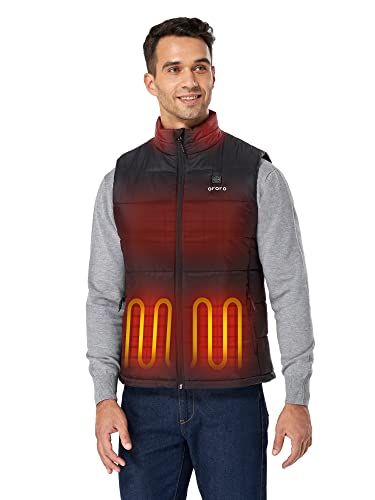 ororo Men's 4-Zone USB-C Heated Puffer VestUSB-C matters more than it sounds: the pack recharges from the same brick as your phone and your laptop, which removes… | Charging off one cable | 37.6 Wh | $149.99View on Amazon |
| 3 |  ororo Men's Soft Shell Heated JacketThe clearest power story in the category: ororo publishes capacity and voltage for every pack it sells, so you can wor… | A first heated jacket | 38.5 Wh | $159.99View on Amazon |
#ad — buy links are tagged and earn us a commission at no extra cost to you. Prices come from a live feed; where none is available the button reads “Check price” rather than showing a number we cannot stand behind. How we are funded.
ororo Men's Lightweight Heated Vest
A vest puts the same pack energy into the same core zones as a jacket while heating far less fabric, which is why it is the smarter buy for most people who think they want a jacket.
#ad No live price available, so we show none. How we are funded.
The numbers
- Energy
- 38.5 Wh
- Pack
- 7.4 V, 5,200 mAh
- Published output
- 2.5 A
- Heat zones
- 3
- Maker's runtime claim
- 8-10 h low / 2-3 h high
- Heat zones
- Left and right chest, mid-back
- Settings
- Three
- Care
- Machine washable with the battery removed
On wattage: No published wattage, but ororo's per-setting hours plus the published pack capacity give you the implied draw at each setting.
What we like
- Layers under any coat you already own, which is what most people actually need
- Identical core zones to the jacket at a lower price
- Arms stay free, which matters for anyone working with their hands
What we do not
- No arm or neck heat at all
- Needs an outer layer in wind
- The same unpublished wattage as everything else here
Who this suits
Almost everyone comparing a first heated purchase. Start here, and add gloves before you add sleeves.
Who should skip it
Your cold problem is your arms or your hands. A vest will not touch either, and one bought to fix cold hands is a wasted purchase.
Spec sources: ororo — Heated Apparel Battery Guide (capacity, voltage and output for every pack) · Amazon — ororo 7.4V 5200mAh battery listing (per-setting runtime claim)
ororo Men's 4-Zone USB-C Heated Puffer Vest
USB-C matters more than it sounds: the pack recharges from the same brick as your phone and your laptop, which removes the proprietary-charger failure mode entirely.
The numbers
- Energy
- 37.6 Wh
- Pack
- ororo PD 5K, 5,075 mAh at 7.4 V
- Published output
- 2.5 A
- Recharge
- USB-C
- Heat zones
- 4
- Heat zones
- Left and right chest, mid-back, collar
- Settings
- Three
- Care
- Machine washable with the battery removed
On wattage: No published wattage. ororo does publish the pack's capacity, voltage and output current, which is three more useful numbers than most of this category prints.
What we like
- USB-C recharge kills the proprietary-brick problem, which is the most common way these packs get abandoned in a drawer
- Puffer insulation means the vest is warm before you switch anything on
- Published capacity, voltage and output amps — unusually complete for this category
What we do not
- Puffer bulk is real under a fitted coat
- Four zones on a 37.6 Wh pack is a thinner spread than three zones on the same energy
- Still no wattage figure
Who this suits
Someone who travels with the vest and does not want a second charger in the bag.
Who should skip it
You need it to disappear under a slim shell. It will not.
Spec sources: ororo — Heated Apparel Battery Guide (capacity, voltage and output for every pack)
ororo Men's Soft Shell Heated Jacket
The clearest power story in the category: ororo publishes capacity and voltage for every pack it sells, so you can work out what you are getting instead of taking a marketing number on faith.
The numbers
- Energy
- 38.5 Wh
- Pack
- 7.4 V, 5,200 mAh (ororo B19G)
- Published output
- 2.5 A
- Heat zones
- 3
- Maker's runtime claim
- 8-10 h low / 5-6 h medium / 2-3 h high
- Heat zones
- Left and right chest, mid-back
- Settings
- Three, cycled from a single chest button
- Care
- Machine washable with the battery removed
On wattage: ororo publishes no wattage for the garment. It does publish hours for each of the three settings, which states the draw whether it meant to or not.
What we like
- ororo publishes capacity AND voltage for every pack, which almost nobody else in this category does
- Per-setting runtime claims rather than one 'up to' number, so the low-to-high spread is visible before you buy
- Soft-shell cut layers under a work coat without bulk
What we do not
- No published wattage for the garment itself
- Three zones only — nothing at the arms or the kidneys
- The headline runtime figure is the low setting, as it is everywhere
Who this suits
Someone standing still outdoors for two to four hours at a stretch who wants the power figures on the table before buying.
Who should skip it
You need heat for a full eight-hour shift on high. No 38 Wh pack does that, and this one does not claim to.
Spec sources: ororo — Heated Apparel Battery Guide (capacity, voltage and output for every pack) · Amazon — ororo 7.4V 5200mAh battery listing (per-setting runtime claim)
Why the vest beats the jacket on the same components
This vest uses the same pack, the same three-zone layout and the same element type as ororo's soft shell jacket. Left chest, right chest, mid-back. Identical electronics.
It gets more out of them for two reasons, and neither is about the battery. There is less fabric to bring up to temperature and less surface area shedding heat. And more importantly, a vest is designed to go under something — which means the coat you already own supplies the insulation and the wind block, so the element only has to top up rather than fight the weather from scratch.
A heated soft-shell jacket worn as an outer layer is frequently less insulated than the coat it replaced. That is the trap: the battery ends up buying back warmth that better layering would have given you for nothing. Layering heated clothing covers the ordering, and jacket versus vest covers the decision.
What the vest is
Three zones, no collar element, no sleeves. A lightweight shell face with minimal insulation of its own — which is a design decision rather than a shortcoming, because the vest assumes something is going over it.
Machine washable with the battery removed, which matters more than it sounds for a layer worn against a shirt. And the pack is ororo's standard apparel battery, meaning capacity, voltage and output current are all published in the maker's own battery guide — the reason this product can be evaluated at all.
Who it suits
- Anyone who already owns a winter coat they like and wants to add heat rather than replace it
- Someone standing still outdoors for two to four hours — spectators, dog walkers, anyone waiting
- Trades workers who need their arms free and their work coat's abrasion resistance intact, covered in heated vests for work
- Anyone comparing a first heated purchase who wants the most warmth per dollar
Who should skip it
- Anyone whose neck is the cold part. Three zones, no collar element. ororo's four-zone models include one; this does not.
- Anyone wanting it as an outer layer in wind. The shell is light and barely insulated. It expects a coat over it, and without one the element is fighting a losing battle.
- Anyone whose real problem is hands or feet. A vest does nothing for either. Heated glove liners cost a fraction of this and address it directly.
- Anyone needing a full shift on high. 38.5 watt-hours against an 18.5 W ceiling is two hours five minutes, and no garment design changes that arithmetic.
Watt-hours, and what they buy
Energy is capacity times nominal voltage. The ceiling draw is the pack’s own published output current times its voltage. The implied draw runs the maker’s advertised hours backwards. Nothing here is measured — check our working.
| Product | Capacity | Volts | Energy | Ceiling draw | Shortest runtime | Implied draw at the claim |
|---|---|---|---|---|---|---|
| ororo Men's Lightweight Heated Vest | 5,200 mAh | 7.4 V | 38.5 Wh | 18.5 W | 2h 05m | 15.4 Wat 2.5 h high |
| ororo Men's 4-Zone USB-C Heated Puffer Vest | 5,075 mAh | 7.4 V | 37.6 Wh | 18.5 W | 2h 02m | 3.8 Wat 10 h maker's headline claim |
| ororo Men's Soft Shell Heated Jacket | 5,200 mAh | 7.4 V | 38.5 Wh | 18.5 W | 2h 05m | 15.4 Wat 2.5 h high |
“Not derivable” means the manufacturer does not publish the figure the sum needs. We leave it blank rather than estimating it, borrowing a number from a similar model, or rounding one into existence. These are ceilings, not promises: cold, wind, movement and pack age all push real runtime below them. Run your own numbers.
The alternatives worth weighing
ororo's USB-C puffer vest adds a collar element and USB-C recharge, on a slightly smaller pack — a real trade rather than a straight upgrade, and worth it specifically if your neck is what is cold or if losing a proprietary charger worries you.
If you are cross-shopping brands, ororo versus Venustas covers coverage against disclosure, and ororo versus Milwaukee covers energy against pack-swapping. The vests hub has the wider format argument.
Frequently asked
- How long does the ororo heated vest last?
- ororo claims 8-10 hours on low, 5-6 on medium and 2-3 on high. Those figures are consistent with the hardware: 38.5 watt-hours against the pack's published 18.5 W delivery ceiling gives a floor of two hours five minutes, which matches the high-setting claim.
- How many watt-hours is the ororo vest battery?
- 38.5 watt-hours — 5,200 mAh at 7.4 V. That is the standard ororo apparel pack, and it is the same battery the brand's soft shell jacket uses.
- Does the ororo heated vest have neck heating?
- Not this model. It runs three zones: left chest, right chest and mid-back. ororo's four-zone fleece and USB-C puffer vests add a collar element, which is the zone most people notice missing.
- Should I buy the ororo vest or the ororo jacket?
- The vest, unless you need the heated garment to be your outer layer. They use the same pack and the same three zones, but the vest costs less, leaves your arms free, and lets a coat you already own do the insulating.
- Can you wear the ororo heated vest under a coat?
- Yes, and that is the intended use and the most efficient one. Your coat blocks the wind and insulates; the vest only has to top up the heat, so the same 38.5 watt-hours goes considerably further.
- Is the ororo heated vest machine washable?
- Yes, with the battery removed, on a cold gentle cycle, dried flat. Never tumble dry and never wash with the pack connected — those are the two reliable ways to break an element run.
Sources
Related

Heated Vests
Same core zones as a jacket, less fabric to heat, and it layers under the coat you already own. Usually the smarter first purchase.

Heated jacket or heated vest? Three questions decide it
Same pack, same elements, different amount of fabric. Three questions that settle which one you should buy.

ororo or Milwaukee? Bigger battery against faster swap
ororo sells energy, Milwaukee sells logistics. Nearly double the watt-hours against a ten-second swap — and which one wins for you.
ororo Soft Shell Heated Jacket: what the published numbers say
The most checkable jacket in the category: every published figure converted, including the draw each setting implies.
Heated vests for work, where free arms beat extra fabric
On site the vest wins on free arms, a reachable battery and a coat that keeps its abrasion resistance. Plus the spare-pack math.
Venustas heated vest: more coverage, fewer numbers
Bigger panels over more of your torso, including the collar, at a low price — and a spec sheet with a hole exactly where the power figures should be.

Gobi Heat: the only brand here that publishes watt-hours — and the one runtime figure it repeats too often
The only apparel brand here that prints the watt-hours on its own battery pages - and the one whose 3-zone and 5-zone garments claim identical runtimes off an identical pack.

ororo heated apparel, and the 2x battery spread hiding inside one brand
The only brand here publishing a full battery lineup - which is how you can see that its packs run 35.4 Wh to 75.1 Wh, and the priciest jacket ships the smallest one.