Heated jackets for extreme cold, and the number that does not move
ororo's high setting is 131F. It is 131F when it is forty out and it is 131F when it is ten below. The element holds a temperature; the cold decides how much of that temperature reaches you instead of the air. Everything on this page follows from that.
By Scooter M. · Published October 30, 2026
How this is funded: buy links here are tagged and earn us a commission at no extra cost to you. It does not affect what we recommend, and we take no free product and no sponsorship. Read the disclosure.

In extreme cold a heated jacket is a supplement, not a substitute. Every maker that publishes a temperature publishes a fixed one - ororo's high is 131F whatever the weather - so as it gets colder the element's output stays flat while the heat escaping through the shell rises. Buy insulation first, watt-hours second.
The temperature every maker publishes is an absolute
Four brands on this site publish an actual temperature for their heat settings. That already makes them unusual - most of this category gives you three unlabelled steps and a runtime. But look at what the four of them have in common.
| Maker | What they publish | Stated as |
|---|---|---|
| ororo | "On low the temperature of the jacket can get up to 100F/38C, on medium 113F/45C and on high 131F/55C" | A fixed figure |
| Fieldsheer | Four settings, published as "90 up to 135F" on both the Tundra and the Ventani | A fixed range |
| Gobi Heat | 113F low, 131F medium, 140F high - on the Sahara II and no other Gobi model | A fixed figure |
| Gerbing | "135F Maximum heat" on the 7V Torrid vest | A fixed ceiling |
| Everyone else here | No temperature published at any setting | Not applicable |
Not one of them is expressed as a rise above ambient. There is no "35F above outside air" setting anywhere in heated apparel, because that is not how the hardware works - a carbon fiber element with a controller holds a target, and the target is a number.
That sounds like a technicality. It is the entire buying argument, and here is why. Heat moves through a jacket shell in proportion to the temperature difference across it. Take ororo's own high setting and do nothing more complicated than subtraction:
- At 40F outside, a 131F element sits 91F above the air on the other side of the shell.
- At 0F outside, the same element on the same setting sits 131F above it - a gradient about 44% larger.
- At -10F outside, it sits 141F above it - about 55% larger than on that 40F day.
Nothing in the garment compensates. The element is not drawing more power; it is holding the same number it held in October. What has changed is the share of its output that goes outward into the air instead of inward into you, and that share rises with the gradient. This is why people who are happy with a heated jacket in the fall are disappointed by the same jacket in January and conclude the battery is failing. The battery is fine. The arithmetic moved.
The second thing that happens below zero: the pack gets smaller
Venustas is the only maker on this site that addresses cold and batteries directly, and to its credit it does not dress it up. From its own battery care page: "In cold conditions, your battery may provide shorter runtime compared with normal conditions. This is a temporary effect and does not necessarily mean the battery is damaged."
Read that against the previous section and the two effects compound in the same direction. On the coldest day of the year you want to run a higher setting than usual, for longer than usual, and you are doing it on a pack that - by the maker's own account - has less to give than its label says. Every published runtime on every listing in this category was measured somewhere that was not ten below.
We are not going to tell you how much less. Nobody in heated apparel publishes a capacity-versus-temperature curve, and the percentages you can find online come from pages that do not say what cell chemistry, what discharge rate or what temperature they are describing. What we will say is the practical consequence, which does not need a number: size the pack as though the day were longer than it is, and carry a second one. That is why a battery is the fifth pick on a page about jackets.
So the criteria change, and they change in a specific order
Our usual order on this site is watt-hours first, because watt-hours are the thing the category hides. For extreme cold that order is wrong, and we would rather say so than be consistent.
- Insulation you can name. A fill power, a fill weight in grams, or a named synthetic. "Water and wind resistant" describes a shell, not a filling, and a surprising number of heated jackets offer nothing but a shell. If the listing cannot tell you what is between the two layers of fabric, assume the answer is air.
- Watt-hours, and whether you can buy more of them. Not zone count, not setting count. A garment on a platform where a bigger pack is an ordinary shelf item has a ceiling you can raise later; a garment with a proprietary connector and one pack size does not.
- Where the pack sits. An interior pocket keeps the cells near body temperature. A hem pocket on the outside of the shell keeps them at ambient, which on this page is the problem we are trying to solve.
- Then the zone map. Heated sleeves are genuinely good and we rate them. They are fourth, because two more elements drawing from the same pack is a cost as well as a benefit, and in deep cold the pack is already the constraint.
Our criteria, and what we did not do
- We ranked on insulation first, energy second and zone map third - which is the opposite of how this category markets itself, and the reason two of the best-specified jackets on this site are in the skip list rather than the picks.
- Every temperature, capacity and runtime figure here is the maker's own, quoted from the pages listed in Sources. Where we converted milliamp-hours into watt-hours we say so and show the multiplication.
- We did not test anything in the cold. We have no cold chamber, no thermocouples and no field data, and a page about extreme cold is exactly where a site would be tempted to invent some.
- We deliberately do NOT state a percentage figure for how much capacity a pack loses below freezing. No maker in this category publishes one, and the numbers circulating online come from sources that do not say what cell, what discharge rate or what temperature they measured.
- Availability was checked on 2026-10-30 before anything was ranked. One garment we wanted to feature - ororo's 750-fill down jacket - came back as "Only 1 left in stock" and was left out of the picks for that reason alone.
We have not worn, tested or owned any of these products, and we say so on every page rather than in a footer. What we do instead is compile the published specifications and do the arithmetic. The full method.
The giveaway: the warmer the jacket, the smaller the pack
Once you sort this category by insulation rather than by spec sheet, something odd shows up. Two brands here sell both an insulated jacket and an uninsulated one, and both of them put the smaller battery on the warmer garment.
| Garment | Insulation | Pack in the box | Energy |
|---|---|---|---|
| Fieldsheer Ventani (women's) | PrimaLoft ThermoPlume | Powersheer Mini, 2,250 mAh at 7.4 V | about 16.7 Wh |
| Fieldsheer Tundra (men's) | None - four-way stretch softshell | 4,000 mAh at 7.4 V | about 29.6 Wh |
| ororo 750-fill down jacket | 90% 750-fill RDS down | Mini 5K, 4,800 mAh | 35.4 Wh, published |
| ororo dual-control jacket | None - water and wind resistant shell | PD 5K, 5,075 mAh at 7.4 V | about 37.6 Wh |
Watt-hour figures are ours except ororo's 35.4 Wh, which ororo publishes. Fieldsheer publishes watt-hours for none of its packs, so both Fieldsheer rows are milliamp-hours multiplied by the stated voltage.
Within Fieldsheer the gap is large: the insulated jacket ships 44% less energy than the softshell, and costs more. Within ororo it is small - 35.4 Wh against 37.6 Wh is a 6% difference and we would not build an argument on it - but it still runs the wrong way, and ororo's own battery guide lists four larger packs it could have used instead.
The interesting part is that the makers are not wrong. An insulated jacket genuinely needs less electricity, because the fill is holding the heat in and the element has less work to do. The pack size is a signal about what the garment is. What it also does, though, is make the warmer jacket look worse on a comparison table - fewer watt-hours, often fewer zones, usually no published runtime - and the softshell look better. If you shop this category the way the category presents itself, the spec sheet will walk you straight past the jacket you want.
Watt-hours, and what they buy
Energy is capacity times nominal voltage. The ceiling draw is the pack’s own published output current times its voltage. The implied draw runs the maker’s advertised hours backwards. Nothing here is measured — check our working.
| Product | Capacity | Volts | Energy | Ceiling draw | Shortest runtime | Implied draw at the claim |
|---|---|---|---|---|---|---|
| Venustas Men's Heated Silent Hunting Jacket (Next Camo G2) | 10,000 mAh | 7.4 V | 74.0 Wh | Not published | Not derivable | 3.7 Wat 20 h manufacturer's headline claim |
| DEWALT DCHJ076A Heated Coat Kit (3XL) | 2,000 mAh | 18 V | 36.0 Wh | Not published | Not derivable | No claim published |
| TIDEWE Heated Jacket with Heated Seat Pocket | 10,000 mAh | 3.7 V | 37.0 Wh | Not published | Not derivable | 12.3 Wat 3 h high |
| Fieldsheer Mobile Warming Women's Ventani Hybrid Heated Jacket | 2,250 mAh | 7.4 V | 16.7 Wh | Not published | Not derivable | 8.3 Wat 2 h high (up to 135°f) |
| ororo PD 7K Rechargeable Battery for Heated Apparel | 7,000 mAh | 7.4 V | 51.8 Wh | 22.2 W | 2h 20m | 3.8 Wat 13.5 h maker's headline claim, with ororo apparel |
“Not derivable” means the manufacturer does not publish the figure the sum needs. We leave it blank rather than estimating it, borrowing a number from a similar model, or rounding one into existence. These are ceilings, not promises: cold, wind, movement and pack age all push real runtime below them. Run your own numbers.
Quick picks
Tap any row to jump to the full write-up below. The energy column is the pack’s capacity times its voltage — the number this category does not print.
| # | Product | Best for | Energy | Price |
|---|---|---|---|---|
| 1 |  Venustas Men's Heated Silent Hunting Jacket (Next Camo G2)74 published watt-hours, five zones including both arms and ultra-silent fabric — the most complete hunting-specific s… | Heated sleeves in camo, on the biggest pack here | 74.0 Wh | $159.99View on Amazon |
| 2 | 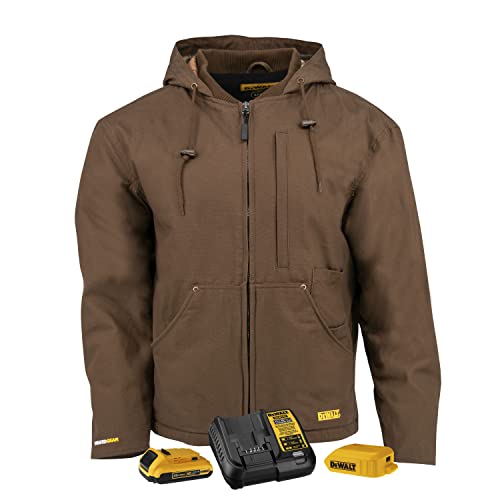 DEWALT DCHJ076A Heated Coat Kit (3XL)The only garment here whose pack is a tool battery, which means the energy ceiling is not the jacket but whatever you … | The largest energy budget in extended sizes | 36.0 Wh | $264.99View on Amazon |
| 3 |  TIDEWE Heated Jacket with Heated Seat PocketFour zones, a waterproof shell, and a heated cushion that unzips out of the back pocket — which is a genuinely good id… | The only jacket here with a heated seat in it | 37.0 Wh | $139.99View on Amazon |
| 4 |  Fieldsheer Mobile Warming Women's Ventani Hybrid Heated JacketPrimaLoft ThermoPlume fill means this one keeps working when the battery dies — but it ships with Fieldsheer's SMALLES… | Real insulation underneath the heat | 16.7 Wh | $219.99View on Amazon |
| 5 |  ororo PD 7K Rechargeable Battery for Heated Apparel7,000 mAh of LG cells with a published 13.5-hour claim and a six-mark certification list — the biggest step up availab… | The largest ororo pack you can actually buy | 51.8 Wh | $89.99View on Amazon |
#ad — buy links are tagged and earn us a commission at no extra cost to you. Prices come from a live feed; where none is available the button reads “Check price” rather than showing a number we cannot stand behind. How we are funded.
Venustas Men's Heated Silent Hunting Jacket (Next Camo G2)
74 published watt-hours, five zones including both arms and ultra-silent fabric — the most complete hunting-specific spec sheet we have converted.
The numbers
- Energy
- 74.0 Wh
- Maker's stated energy
- 74 Wh at 7.4 V — published by Venustas
- Arms heated
- Yes — 2 of the 5 zones
- Fabric
- Ultra-silent, FELLEX insulation, Next Camo G2
- Sizes
- S to 4XL
- Heat zones
- Left and right chest, left and right arm, and mid-back, per Venustas
- Settings
- Three — low, medium and high. No temperatures published
- Care
- Machine washable, per Venustas
On wattage: No wattage published. Venustas's own figures invert to about 3.7 W for the whole garment at the 20-hour claim — roughly 0.74 W per zone across five zones. That is a very low draw, which tells you the 20-hour figure describes the LOWEST setting on an insulated garment rather than anything you would run in real cold. Venustas does not say which setting it refers to, and we will not assume.
On the pack: Venustas publishes "74Wh" directly rather than making you multiply a milliamp-hour figure by a voltage it never states. At 74 Wh this is the largest apparel pack on this site — nearly double a standard 7.4 V 5,200 mAh pack, and twice what the TIDEWE hunting jacket carries. On a long sit that is the number that matters most.
What we like
- Venustas publishes the watt-hours itself, which almost nobody in this category does
- 74 Wh is the largest apparel pack on this site — twice what the TIDEWE hunting jacket carries
- Ultra-silent fabric is a genuine hunting specification, not a marketing adjective
- Two of the five zones are in the arms, which most heated jackets skip entirely
- A three-year element warranty is advertised — though Venustas marks that term "Venustas Official Website Only", so check before assuming it covers a retail purchase
What we do not
- No temperatures and no per-setting runtimes — the 20-hour claim is one number with no setting attached
- Two of your five zones go to the arms, which on a motionless sit is not where you lose heat
- Heated sleeves add bulk at the shoulder and inner arm, which is where a stock or a bowstring goes
- Costs meaningfully more than the same brand's hunting vest on the identical battery
- No wattage published, so the draw is our inference from their runtime claim
Who this suits
A hunter who walks in a long way, or genuinely gets cold arms sitting, and wants camo and silence as well as heat.
Who should skip it
Your hunting is mostly sitting still. Two of the five zones are heating the part of you that needs to move freely, and the same brand's vest spends those zones on your neck and lower back instead.
DEWALT DCHJ076A Heated Coat Kit (3XL)
The only garment here whose pack is a tool battery, which means the energy ceiling is not the jacket but whatever you are willing to buy: a 5.0 Ah 20V MAX holds 90 Wh against the 38.5 Wh most heated jackets ship with.
#ad Price as of October 30, 2026. How we are funded.
The numbers
- Energy
- 36.0 Wh
- Sizes
- This listing is the 3XL
- Pack
- 20V MAX, 18 V nominal — kit ships 2.0 Ah
- Shell
- Water- and wind-resistant duck canvas
- Zones
- Five, including both arms
- Heat zones
- Left chest, right chest, both arms and mid-back, per DEWALT
- Settings
- Three, plus a preheat function
- Care
- Not stated by DEWALT on the kit page
On wattage: DEWALT publishes no draw figure and no per-setting runtime on the kit page, so nothing here can be inverted. What it does publish is the zone layout and the setting count, which is more than most.
On the pack: The kit ships the compact 2.0 Ah pack. The jacket takes any 20V MAX pack, so the ceiling is whatever you already own — a 5.0 Ah holds 90 Wh, against 38.5 Wh for the 5,200 mAh pack most heated jackets ship with, and it is still inside the FAA carry-on threshold.
What we like
- Five zones including the arms, which most jackets at any price leave unheated
- Runs on a platform where a 90 Wh pack is an ordinary shelf item
- Duck canvas shell that survives a worksite rather than a commute
- Battery and charger are in the box, so there is no second purchase
What we do not
- No published wattage and no per-setting runtime, so the draw cannot be derived
- The 2.0 Ah pack in the kit holds 36 Wh — respectable, but the appeal is the packs you add later
- Heavy. This is a work coat with a tool battery in the pocket, not a layer
- DEWALT does not publish washing instructions on the kit page
Who this suits
Someone in an extended size who already owns 20V MAX packs, or who wants the option of a 90 Wh pack rather than a 38 Wh one.
Who should skip it
You do not own the platform and do not want to. Bought outright, the pack-and-charger premium is real and a consumer jacket costs less.
Spec sources: DEWALT — Heavy Duty Tobacco Heated Work Jacket Kit (five heating zones, three temperature settings plus preheat, 1-year limited warranty) · DEWALT — 20V MAX 2.0 Ah battery (DCB203)
TIDEWE Heated Jacket with Heated Seat Pocket
Four zones, a waterproof shell, and a heated cushion that unzips out of the back pocket — which is a genuinely good idea for anyone who sits on cold ground, and the reason this is the pick for a stand hunt.
The numbers
- Energy
- 37.0 Wh
- Zones
- Four, plus the heated seat
- Pack
- 10,000 mAh USB bank, about 37 Wh
- Claims
- 10 h low / 5.5 h medium / 3 h high
- Shell
- Waterproof polyester with 120 g insulation
- Heat zones
- Four target zones, plus a separately heated seat cushion in the back pocket
- Settings
- Three, color-coded on the controller
- Care
- Not stated on this listing
On wattage: No wattage published. Against 37 Wh, the three claims invert to roughly 3.7 W on low, 6.7 W on medium and 12.3 W on high — believable for four zones, and near-identical to what TIDEWE's own vest and pants imply. That is worth noticing: three garments with different zone counts and different areas, all quoting the same runtime triplet.
On the pack: Runs off TIDEWE's 10,000 mAh USB power bank — about 37 Wh once you rate it the way USB banks are rated. The same pack powers TIDEWE's vest, pants and seat cushion, so one spare covers the whole outfit.
What we like
- The heated seat cushion is a real answer to sitting on frozen ground, and nothing else on this site has one
- A runtime published for all three settings, so the claims can be inverted
- Waterproof shell in a hunting pattern, which narrows the field considerably
- Shares one pack with TIDEWE's vest, pants and gloves-adjacent gear
What we do not
- No wattage published, and the pack's capacity has to be read at cell voltage to make sense
- The same 10/5.5/3 triplet appears on garments with different zone counts, which suggests a line-wide figure rather than a per-garment measurement
- No care instructions on the listing
- Camo only in this variant, which is the wrong look away from a hunt
Who this suits
A hunter who sits still on cold ground and wants the seat heated as well as the torso.
Who should skip it
You want a jacket for town. The pattern, the cut and the seat cushion are all built for a hide.
Spec sources: Amazon — TIDEWE heated jacket with zippered back pocket heater, Next Camo G2 (four heating zones, three levels, 10 h low / 5.5 h medium / 3 h high, 10,000 mAh pack) · TIDEWE — 10,000 mAh power bank for heated apparel (5 V / 2.4 A dual-USB output, 6.7 oz, UL/FCC/RoHS/CE, one-year warranty)
Fieldsheer Mobile Warming Women's Ventani Hybrid Heated Jacket
PrimaLoft ThermoPlume fill means this one keeps working when the battery dies — but it ships with Fieldsheer's SMALLEST pack, 2,250 mAh, and that is the number to look at.
#ad Price as of October 30, 2026. How we are funded.
The numbers
- Energy
- 16.7 Wh
- Maker's stated energy
- 7.4 V, 2,250 mAh — about 16.7 Wh by our arithmetic
- Insulation
- PrimaLoft ThermoPlume synthetic down fill
- Shell
- 100% nylon, water resistant, PFC/PFAS-free DWR
- Claims
- All four settings, with temperatures
- Heat zones
- Two chest and one back, per Fieldsheer
- Settings
- Four adjustable settings, published as 90° up to 135°F
- Care
- Machine wash cold on gentle only, tumble dry low, per Fieldsheer
On wattage: Not published. 16.7 Wh over the claimed 2+ hours on high implies about 8.3 W across three zones, or roughly 2.8 W per zone — consistent with Fieldsheer's other three-zone garments. The claim is internally sound; the pack is simply small.
On the pack: The Powersheer Mini: 7.4 V, 2,250 mAh, about 16.7 Wh by our arithmetic. That is the smallest pack Fieldsheer lists and it is what comes in the box with a full-price insulated jacket. The 4,000 mAh pack from the Tundra uses the same 7.4 V system.
What we like
- Actual synthetic down insulation, so it is a warm jacket before you switch anything on
- Four settings with temperatures and a runtime for each
- PFC/PFAS-free DWR finish, which is still uncommon in this category
- Takes the larger 7.4 V packs, so the small battery is fixable
What we do not
- Ships with Fieldsheer's smallest pack — 2,250 mAh, roughly 16.7 Wh
- About half the energy of the men's Tundra for a higher list price
- No watt-hours published by Fieldsheer on any pack, so every energy figure here is ours
- Three zones, no heated sleeves
Who this suits
A woman who wants a genuinely insulated jacket first and a heated one second, and who is willing to buy a bigger pack.
Who should skip it
You expect a long day on the battery in the box. 16.7 Wh is the smallest energy budget of any full-price jacket on this site.
Spec sources: Fieldsheer — Ventani Hybrid Heated Jacket Women's ("3-Zone Heating System - 2x Chest & 1x Back"; "4 Adjustable Heat Settings (90° up to 135°)"; "2+ High, 3+ MedHigh, 4+ MedLow, 9+ Low"; Powersheer Mini 7.4V 2250 mAh, model MWCB74V02221; 100% nylon water-resistant shell, PrimaLoft ThermoPlume fill; machine wash cold gentle; 1 year warranty) · Fieldsheer — Battery Technologies (lists eight packs across three voltages: Powersheer 12V, 7.4V+ Plus, 7.4V Standard Li-Ion, Soft Touch 7.4V, 7.4V Heated Glove Battery, 3.7V Premium Sock Battery, 3.7V Standard Sock Battery, 3.7V Thawdaddy — with no mAh, Wh or runtime figure for any of them)
ororo PD 7K Rechargeable Battery for Heated Apparel
7,000 mAh of LG cells with a published 13.5-hour claim and a six-mark certification list — the biggest step up available to an ororo owner, because the larger PD 10K is not sold through this retailer.
#ad Price as of October 30, 2026. How we are funded.
The numbers
- Energy
- 51.8 Wh
- Capacity
- 7,000 mAh at 7.27 V — about 50.9 Wh
- Published output
- 30 W out, up to 24 W in
- Recharge
- Fully recharged within 3 hours
- Certification
- UL2056, CE, FCC, CB, WEEE, CA65 per ororo
- Heat zones
- Not applicable — this is a battery
- Settings
- Garment-dependent
- Care
- Not washable — remove before laundering the garment
On wattage: No garment wattage is published, but this pack states its own delivery figures: "up to 24W input" and "30W output". The 30 W output is a ceiling for charging devices rather than a figure any ororo garment draws — inverting the 13.5-hour claim against about 50.9 Wh gives roughly 3.8 W, which is the draw that claim actually assumes.
On the pack: Worth reading the voltage twice. This pack's own product page gives "7.27V", while ororo's battery guide lists the PD 7K at 7.4 V. At 7.27 V the 7,000 mAh works out to about 50.9 Wh; at 7.4 V it is 51.8 Wh. We use the figure printed on the product page itself and note the 2% disagreement rather than quietly picking the flattering one.
What we like
- The largest ororo pack actually purchasable here — roughly 43% more energy than the Mini 5K that ships with several ororo garments
- ororo publishes a real certification list, with UL2056 printed on the casing
- USB-C in and out at 30 W means it doubles as a fast phone bank
- Three-hour full recharge is quick for this capacity
What we do not
- ororo's own two pages disagree on the voltage — 7.27 V on the product page, 7.4 V in the battery guide
- No watt-hour figure printed for this pack, unlike ororo's Mini 5K and PD 5K pages
- The larger PD 10K exists in ororo's lineup but is not sold through this retailer
- Costs a meaningful fraction of a whole garment, which is the usual complaint about spare packs
Who this suits
An ororo owner whose garment shipped with a Mini 5K and who has discovered that the battery, not the jacket, is what ends their day.
Who should skip it
Your garment already ships a PD 5K or larger and your days are short. The jump from 37.5 Wh to 50.9 Wh is real but it is not transformative.
Spec sources: ororo — 7000 mAh PD 7K Rechargeable Battery ("7,000mAh" with "premium LG cells"; voltage given as "7.27V" on this page against 7.4 V in ororo's battery guide; "up to 24W input"; "30W output"; "fully recharged within 3 hours"; "up to 13.5 hours of heat"; "UL2056, CE, FCC, CB, WEEE, CA65 certified"; "1 USB-C Port, 1 USB-C Cable, 1 DC Port"; NTC sensor) · ororo — Heated Apparel Battery Guide (capacity, voltage and output for every pack)
Venustas Men's Heated Silent Hunting Jacket (Next Camo G2)
- Energy in the pack
- (10,000 mAh ÷ 1000) × 7.4 V = 74.0 Wh
- Most the pack can deliver
- Not published — no output current stated, so the ceiling cannot be computed.
- And the draw the maker’s own claim assumes
- 74.0 Wh ÷ 20 h = 3.7 W — which is the manufacturer's headline claim figure.
Where the battery goes, and what we cannot tell you about it
The cells in an apparel pack sit wherever the garment puts them, and a pocket on the outside of the shell is on the cold side of the insulation. Almost nobody lists this, which is why it is worth saying that one maker does: ororo's 750-fill down jacket puts "interior battery pocket" in its own pocket list. That jacket is not among the picks below - we checked its listing on 2026-10-30 and it came back as "Only 1 left in stock", which is not a recommendation we can responsibly make - but the detail is the right one to look for on whatever you do buy.
What we cannot tell you is an operating temperature range, because not one heated apparel maker on this site publishes one. Tool platforms are a partial exception - Milwaukee and DEWALT both market their packs as cold-capable - but the figures appear in retailer copy rather than on a specification sheet, and the European and North American versions of Milwaukee's own claim do not agree with each other. We are not going to launder a marketing line into a specification by quoting it as though it were one.
So the honest guidance is behavioral rather than numeric: keep the pack inboard, start the day with it warm rather than out of a cold truck, and carry the spare somewhere inside your coat rather than in a pack on your back. None of that is a substitute for buying enough energy in the first place, which is what the watt-hour page is for.
What we would skip, and why
- A softshell, however good its spec sheet is
- This is the recommendation that costs us the most, because the two best-documented jackets on this entire site are softshells. The Fieldsheer Tundra publishes a temperature AND a runtime for all four of its settings, which only Gobi's Sahara II comes close to matching. The ororo dual-control jacket puts the sleeves on their own switch, which nothing else here does at all. We rate both highly and we would not buy either one for a day at ten below. Fieldsheer's own listing calls the Tundra a four-way stretch softshell; ororo describes its dual-control shell as water and wind resistant. Neither claim is an insulation claim, and in deep cold a fixed-temperature element with nothing to hold its output in is spending most of itself on the sky.
- Buying zones instead of buying fill
- Five zones on 30 watt-hours is 30 watt-hours divided five ways. Zone count tells you where the heat lands, not how much of it there is, and it tells you nothing at all about how long the garment holds what it makes. On a mild commute that trade is fine. Below zero the ordering flips: the insulation is carrying the load, the element is topping it up, and an extra pair of elements in the sleeves is drawing from the same pack that has to last the day. Buy the fill weight first and the zone map second.
- The Milwaukee M12 TOUGHSHELL, for this specific job
- We like the M12 line and we rate the TOUGHSHELL elsewhere, but two things rule it out here. The first is energy: an M12 2.0 Ah pack is 10.8 V nominal, not 12, which puts it at about 21.6 watt-hours - the smallest torso budget of anything we would consider for a cold day. The second is simpler. We checked the listing on 2026-10-30 and Amazon returned "Currently unavailable" with no price, so we could not put a buy link on it even if the arithmetic worked.
- A 5V USB platform below zero
- The ActionHeat line and the various USB power-bank garments are a real and sometimes sensible way into heated apparel, and we cover them properly on the ActionHeat page. They are the wrong tool here. A USB bank is rated at its 3.7 V cell voltage rather than the 5 V the garment runs at, which is why a "10,000 mAh" bank is about 37 Wh and not 50, and the conversion step itself is not free. On a mild day that is a fair trade for charging everything off one cable. On the coldest day of the year you want the energy, not the convenience - and 5V USB against 7.4V works through the rest of the difference.
- Anything whose energy you cannot establish before you buy
- The general rule on this site is that a runtime without a capacity is unfalsifiable. In extreme cold it gets worse than unfalsifiable, because the one maker here who addresses cold at all - Venustas - says plainly that cold shortens runtime without saying by how much. So a published 10-hour claim is a 10-hour claim at some unstated temperature, reduced by some unstated amount, at the temperature you actually care about. If the listing will not give you milliamp-hours and a voltage, there is no arithmetic to do and no way to size a spare.
What this page is not telling you
We have not tested any of these jackets in extreme cold, and this is precisely the kind of page where that temptation is strongest. There is no cold chamber here, no thermocouple data and no "we wore it at minus fifteen for six hours" claim, because none of that happened. Every figure above is a manufacturer's published number or a multiplication we have shown our working for.
We have also not given you a temperature rating, and no maker in this category gives you one either. Nobody publishes "comfortable to -20F" for a heated jacket, which is unusual in outdoor apparel and probably sensible - the answer depends on what you are doing, what is underneath, and whether the wind is moving. Treat any site that gives you a number for this as having invented it.
And the biggest omission: a heated jacket is one layer of an outfit. In genuinely severe cold your hands and feet fail before your core does, which is why the heated apparel that gets the most use in deep winter is usually gloves and socks rather than a jacket. If you are cold-weather shopping with a fixed budget and your extremities are the problem, a jacket is not where the money should go first.
Frequently asked
- Do heated jackets actually work in extreme cold?
- Yes, but as a supplement rather than a heater. The element holds a fixed temperature - ororo publishes 131F on high - and it holds that temperature regardless of what the weather is doing. What changes as it gets colder is how much of the element's output escapes through the shell instead of reaching you. A heated jacket with real insulation works very well below zero. A heated softshell is a jacket with a battery in it.
- What temperature do heated jackets reach?
- Where it is published at all: ororo gives 100F, 113F and 131F for its three settings; Gobi gives 113F, 131F and 140F for the Sahara II; Fieldsheer gives a 90F to 135F range across four settings; Gerbing publishes a 135F ceiling on its 7V Torrid vest. Most makers publish nothing. Every one of those figures is an absolute temperature, not a rise above the outside air.
- Will the battery die faster in very cold weather?
- Venustas says so directly on its own battery care page: "In cold conditions, your battery may provide shorter runtime compared with normal conditions. This is a temporary effect and does not necessarily mean the battery is damaged." No maker in this category publishes how much shorter, and we are not going to guess a percentage. Plan for less than the label, keep the pack in an inside pocket, and carry a spare.
- Should I buy a heated jacket or just a warmer jacket?
- For the coldest days, buy the warmer jacket - and if it happens to be heated as well, better. The ranking on this page puts insulation above watt-hours for that reason. A heated jacket earns its price when you are stationary in the cold for long periods, because that is the situation where your own body is not generating enough heat for the insulation to hold on to. It earns it least when the alternative is simply a thicker coat.
- How many watt-hours do I need for a full day below zero?
- There is no honest universal answer, because the draw depends on the garment and almost nobody publishes it. What the numbers here allow is a shape: the biggest apparel pack on this site is Venustas's published 74 Wh, the DEWALT platform will take a 90 Wh tool battery, and the smallest pack shipped with a full-price jacket here is about 16.7 Wh. If your day is long and cold, the top of that range is where to be looking, and a second pack is cheaper than a second jacket.
- Are heated sleeves worth it in extreme cold?
- They are good, and they are fourth on our list. Two more elements draw from the same pack, and below zero the pack is already the binding constraint. If you are choosing between an insulated jacket with three zones and a softshell with five including sleeves, take the three. If both have real insulation, take the sleeves.
- Does a tool-battery jacket make sense for cold weather?
- It is the one route on this site where you can buy more energy off a shelf. The DEWALT coat here ships a 2.0 Ah 20V MAX pack - about 36 Wh at the honest 18 V nominal - but it takes any 20V MAX pack, and a 5.0 Ah holds roughly 90 Wh. The cost is weight and bulk: a tool battery in a jacket pocket is a tool battery, not a flat pouch.
Sources
- ororo - The Beginner's Guide to Your New ororo Heated Clothing ("On low the temperature of the jacket can get up to 100°F/38°C, on medium 113°F/45°C and on high 131°F/55°C"; "the higher the heat setting, the faster you'll burn through your battery"; remove the battery and keep the power cable plugged in and zipped closed before washing. No runtime, no operating temperature range and no cold-weather battery guidance is given)
- Venustas - How to Extend Your Heated Clothing Battery Life ("In cold conditions, your battery may provide shorter runtime compared with normal conditions. This is a temporary effect and does not necessarily mean the battery is damaged."; "repeated exposure to extreme temperatures, especially excessive heat, may impact long-term battery performance"; store at "ideally around 50%" charge, "keep it in a cool, dry indoor location" and "do not store it in freezing environments for a long time". No numeric operating or storage temperature range is published)
- ororo - Heated Apparel Battery Guide (capacity, voltage and output for every pack; the Mini 5K published as "4800 mAh, 7.4V, and 35.4Wh", and four larger packs listed above it)
- Venustas - Men's Heated Silent Hunting Jacket, Next Camo G2 ("74Wh" published directly; five zones given as left and right chest, left and right arm and mid-back; ultra-silent fabric with FELLEX insulation; a single "Up to 20H" headline claim with no setting attached; sizes S to 4XL)
- DEWALT - DCHJ076ATD1 Heavy Duty Tobacco Heated Work Jacket Kit (five zones including both arms and mid-back; three heat settings plus a preheat function; water- and wind-resistant duck canvas; LED controller; 1-year limited warranty; kit ships the 2.0 Ah 20V MAX pack. No wattage and no per-setting runtime published)
- DEWALT - DCB203 20V MAX 2.0 Ah battery (20V MAX is 18 V nominal, which puts the 2.0 Ah pack at about 36 Wh and a 5.0 Ah pack at about 90 Wh)
- Fieldsheer - Ventani Hybrid Heated Jacket, women's (PrimaLoft ThermoPlume fill; 100% nylon shell with PFC/PFAS-free DWR; three zones, two chest and one back; four settings published as 90°F up to 135°F with 2 / 3 / 4 / 9 hour claims; Powersheer Mini pack, 7.4 V and 2,250 mAh; machine wash cold on gentle; 1 year warranty)
- Fieldsheer - Tundra Heated Jacket, men's (four-way stretch softshell; five zones, two chest, one back and two arms; four settings published as 90°F up to 135°F with 2 / 3 / 4 / 8 hour claims; 7.4 V 4,000 mAh pack, model MWCB74V04021)
- Gobi Heat - Sahara II Men's Heated Jacket (the only Gobi product page that publishes temperatures: Low 113°F / Medium 131°F / High 140°F; three zones, chest and back; low up to 10 hrs / medium up to 8 hrs / high up to 5 hrs; 5,000 mAh USB-C PD battery; polyester and spandex blend; 1 year warranty)
- ororo - Men's Heated Down Jacket, 750-fill (90% 750-fill power RDS-certified duck down; four zones given as left and right pocket, collar and mid-back; detachable down-filled hood; five YKK zippered pockets including an interior battery pocket; ships the Mini 5K. No runtime and no wattage published for this garment)
- TIDEWE - Heated Jacket with Zippered Back Pocket Heater (four zones plus a separately heated seat cushion; three settings claimed at 10 h low / 5.5 h medium / 3 h high; waterproof polyester with 120 g insulation; 10,000 mAh USB power bank; one year against defects in materials and workmanship)
- ororo - PD 7K Rechargeable Battery (7,000 mAh; the product page states "7.27V" while ororo's battery guide lists the PD 7K at 7.4 V; "up to 24W input" and "30W output"; fully recharged within 3 hours; UL2056, CE, FCC, CB, WEEE and CA65 listed)
Related
Heated Jackets
The biggest category and the noisiest claims. We convert capacity and voltage into watt-hours, then into hours at each setting.
Heated jackets for work, where the runtime claim meets an eight-hour shift
Why the runtime question on a job site is really a logistics question, and which jackets answer it.
Layering heated clothing: the free upgrade almost nobody uses
Heat source inside the insulation, weather protection outside. The ordering is free and almost everyone gets it backwards.

Watts, volts and the number on the label that is not quite true
Volts, amps, watt-hours and the labeling convention that overstates every tool-battery jacket by 11%.
Spare and replacement batteries, converted before you buy
A second pack is the cheapest real upgrade here. Every capacity claim converted to watt-hours, with the airline band attached — including the class that quietly stops being carry-on legal.

Heated vests for skiing, and why the jacket is the wrong garment
Your ski shell is not replaceable and a heated jacket is not a shell - the vest is the only layer that fits underneath. Plus why a 37 watt-hour pack covers a full day once you stop leaving it on.

Heated jackets for hunting, and the arms question nobody asks
One brand sells the same hunting garment as a jacket and a vest - same battery, same five zones. Only the placement changes, and for a long sit that is the whole decision.
How heated clothing actually works
Element, controller, battery — and why insulation is the half of the system nobody sells you.